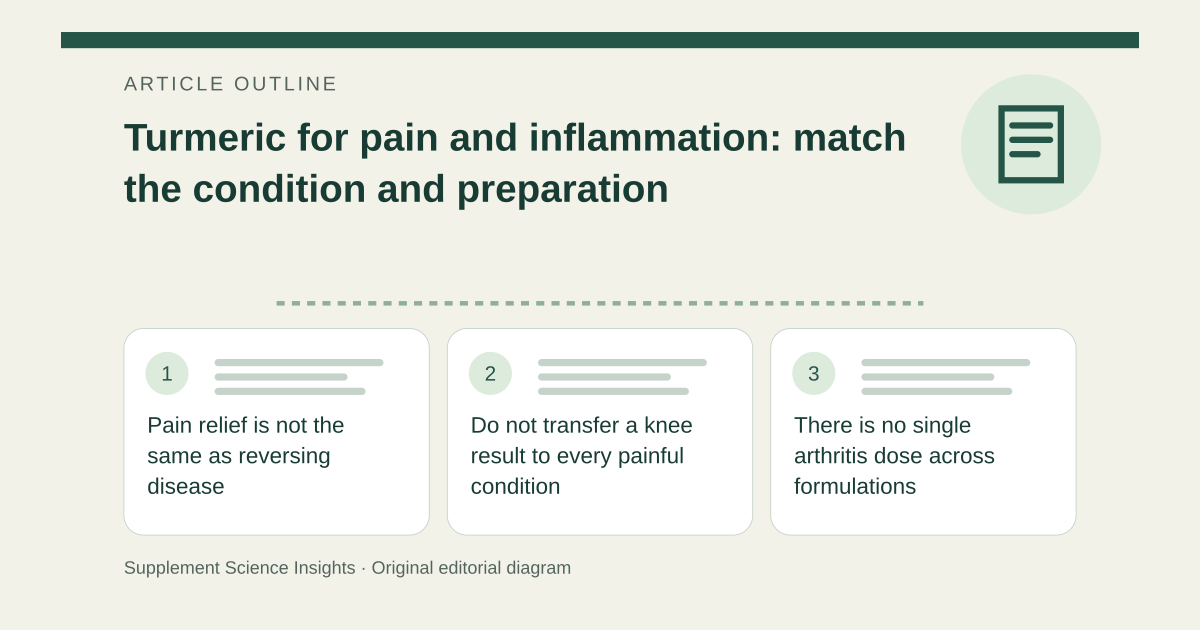
Pain relief is not the same as reversing disease
NCCIH describes preliminary positive findings for knee pain, stiffness and related function while calling for better evidence. Those outcomes do not establish cartilage regrowth or a cure for arthritis. A description such as golden herb is not a standardized medical treatment or a specification of the preparation. [1]
Do not transfer a knee result to every painful condition
Joint inflammation, muscle soreness and nerve pain are different problems. The NCCIH summary does not establish definite benefits for all other conditions. A general anti-inflammatory label cannot fill that evidence gap or identify the cause of a new symptom. [1][2]
There is no single arthritis dose across formulations
Powder, concentrated curcumin, absorption-enhanced products and ointments are not equivalent. NCCIH specifically describes product variation and uncertain topical knee-pain effects. A useful dose comparison must retain the exact formulation, duration, population and outcome; these sources do not justify a universal amount or brand recommendation. [1]
Possible benefit belongs beside safety and established care
Oral turmeric can cause gastrointestinal symptoms, and liver injury has been reported with some enhanced-absorption formulations. Discuss proposed supplement use alongside medicines and the existing treatment plan. Do not treat supplement use as a reason to delay evaluation of a swollen, painful or otherwise concerning joint. [1][2]
Ask what actually improved
Imagine a product advertisement says a study reduced inflammation, but the reported result is a knee-pain score. Ask whether inflammatory markers or structural changes were measured before accepting the broader claim. Even a real symptom benefit should be described at the level the evidence supports. [1]
| Finding | Not automatically demonstrated |
|---|---|
| Less knee pain | Cartilage regrowth |
| Oral preparation benefit | Equivalent ointment effect |
| One condition studied | Treatment of all pain |
Sources for this article
- Turmeric: Usefulness and Safety | NCCIH
Source consulted: 2026-09-21. This is a reference resource, not a claim that we conducted the studies or tested a product. - Joint pain - NHS
Source consulted: 2026-09-21. This is a reference resource, not a claim that we conducted the studies or tested a product.