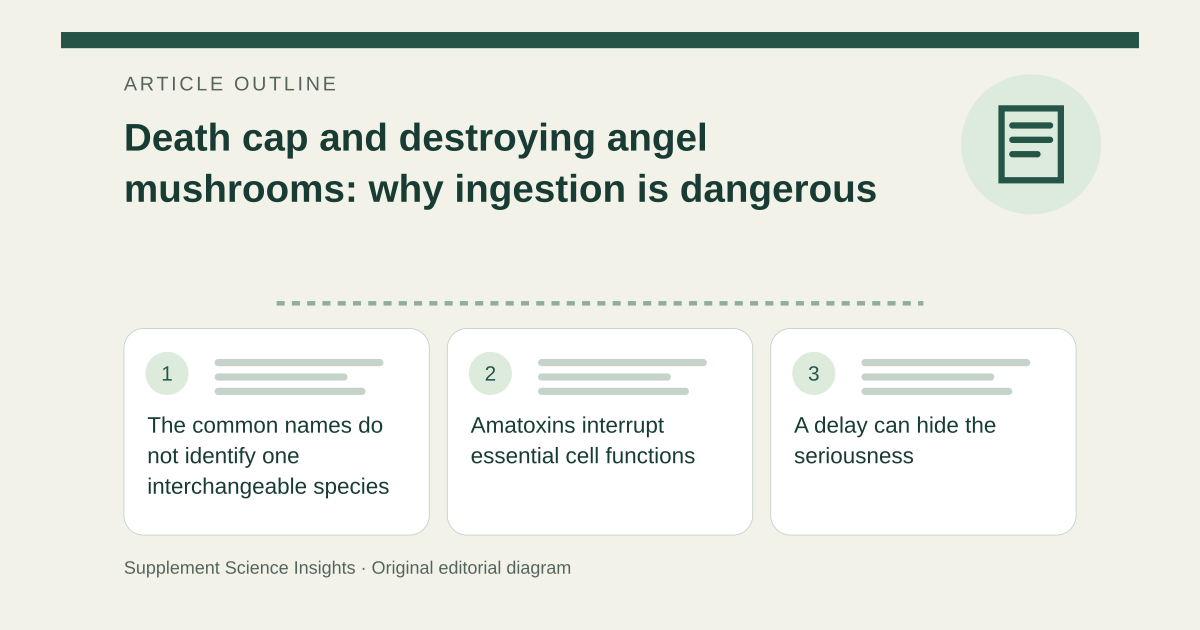
The common names do not identify one interchangeable species
Death cap refers to Amanita phalloides. Destroying angel is used for several related species, including Amanita bisporigera and Amanita ocreata. Death angel is an informal name commonly used in this context; a common name alone is not a reliable species identification. [1][2]
Amatoxins interrupt essential cell functions
CDC describes absorption from the gut and uptake into liver cells, where amatoxins impair protein synthesis. This can cause liver-cell death and liver failure. Serious kidney injury can also occur. This poisoning is different from an ordinary unpleasant meal or a desired psychoactive effect. [2]
A delay can hide the seriousness
Abdominal pain, vomiting and diarrhea may begin more than six hours after ingestion. Early laboratory results may not yet show liver damage. Subsequent liver injury can progress over days. Do not use the absence of immediate symptoms as a reason to wait for an uncertain mushroom to prove itself safe. [2]
Possible ingestion calls for prompt expert advice
Contact Poison Control promptly after a possible poisonous-mushroom ingestion; in the United States call 1-800-222-1222. Call emergency services for collapse, a seizure, breathing difficulty or inability to wake the person. Do not induce vomiting. Identification and treatment should proceed with clinical and poison specialists, not an online appearance checklist. [3][2]
Dangerous does not mean treatment is hopeless
The CDC report describes people who recovered as well as patients who required transplantation or died. Early recognition matters. Imagine two people ate the same foraged meal and only one feels sick: the symptom-free person still needs exposure advice rather than reassurance from the other person’s timing. [2]
| Observation | What it cannot establish |
|---|---|
| Common name or photograph | Reliable edible identification |
| No immediate symptoms | Absence of poisoning |
| Early reassuring blood test | No later liver injury |
Sources for this article
- Cornell University Department of Animal Science
Source consulted: 2026-09-21. This is a reference resource, not a claim that we conducted the studies or tested a product. - Amanita Species Mushroom Poisonings — Northern California, November 2025–March 2026 | MMWR
Source consulted: 2026-09-21. This is a reference resource, not a claim that we conducted the studies or tested a product. - Poison Control: First aid guidelines
Source consulted: 2026-09-21. This is a reference resource, not a claim that we conducted the studies or tested a product.