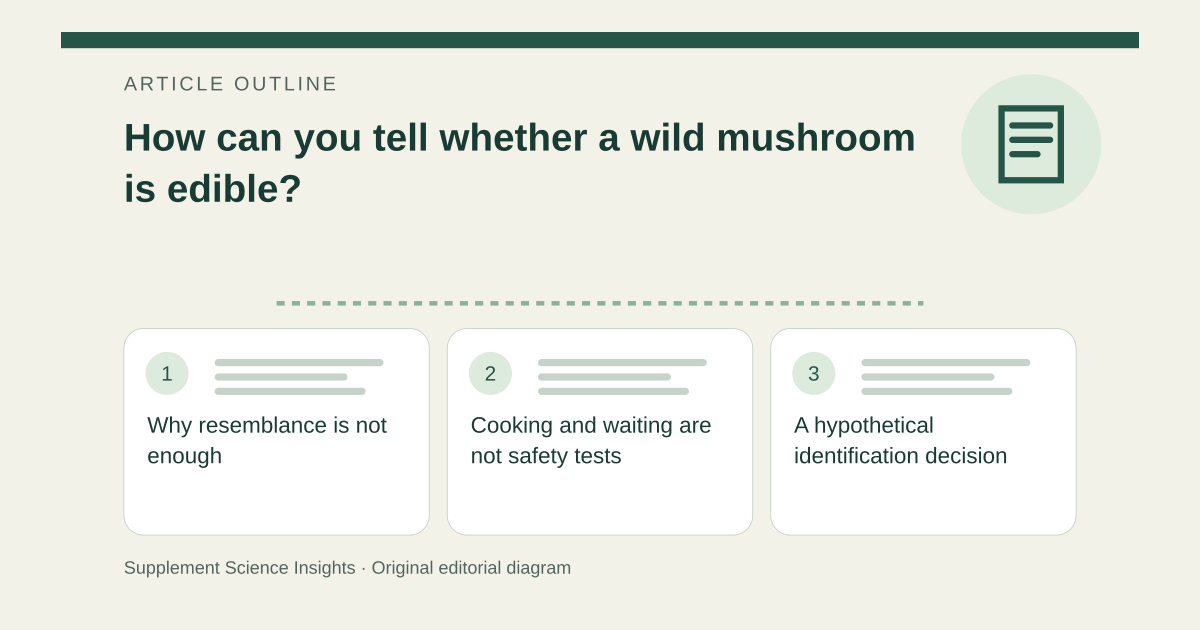
Why resemblance is not enough
A wild mushroom that resembles a supermarket mushroom may still be poisonous. The Minnesota Regional Poison Center advises against eating a found mushroom unless a trained mushroom expert has identified it. Familiar-looking features from another region are not a reliable substitute for local expertise. Color, a common name or a reassuring photograph does not settle the question. [1]
Cooking and waiting are not safety tests
Ordinary cooking does not make a poisonous mushroom safe. Symptoms can also be delayed for hours or days, so feeling well immediately after eating is not reassurance. If someone may have swallowed an unidentified wild mushroom, call Poison Help in the United States at 1-800-222-1222 immediately. Poison specialists can arrange expert identification; do not wait for symptoms before calling. [1]
A hypothetical identification decision
Imagine a found mushroom resembles an edible species in a photograph, but nobody qualified has examined the specimen. The useful conclusion is “identity unresolved,” not “probably edible.” Keep it out of the meal. A general article can explain why the evidence is insufficient, but it cannot authenticate that specimen remotely. [1]
| Information available | What it establishes |
|---|---|
| A similar photograph | A resemblance, not confirmed identity |
| No immediate symptoms after ingestion | Does not exclude delayed poisoning |
| Expert identification | Needed before deciding whether a found mushroom is edible |
Sources for this article
- Wild Mushrooms · Minnesota Regional Poison CenterWild Mushrooms – Minnesota Regional Poison Center
Source consulted: 2026-09-20. This is a reference resource, not a claim that we conducted the studies or tested a product.