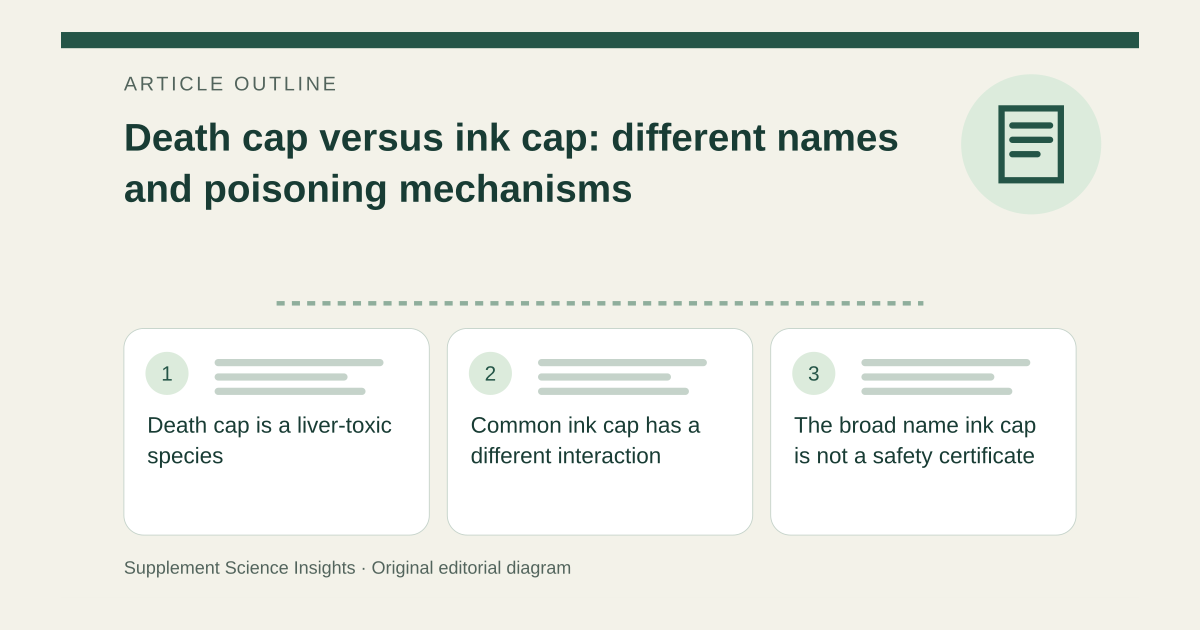
Death cap is a liver-toxic species
Amanita phalloides contains amatoxins. Public-health guidance describes delayed gastrointestinal illness followed in severe cases by liver and kidney failure. A symptom-free interval or temporary improvement is not a reason to dismiss a suspected ingestion. [1][2]
Common ink cap has a different interaction
The clinical toxicology review describes coprine poisoning associated with common ink cap. Coprine interferes with alcohol breakdown and can produce flushing, sweating, rapid heartbeat, nausea and vomiting, with low blood pressure possible. This is not the same mechanism as death-cap poisoning. [3]
The broad name ink cap is not a safety certificate
Common names and resemblance do not reliably settle species identity. A comparison of toxin mechanisms is not a field key. Expert identification considers the complete mushroom, including its base and underside, and the habitat and growth context. Do not use a presumed alcohol-free interval to make an unidentified mushroom acceptable to eat. [4][5]
Describe the full exposure when seeking help
Imagine illness follows an uncertain mushroom meal with alcohol. Tell Poison Control about the meal, alcohol, timing and all symptoms, and save specimens. Do not self-diagnose a less serious ink-cap reaction and overlook another toxin. [3][5]
| Claim | What it cannot establish |
|---|---|
| Looks like an ink cap | Confirmed species |
| Symptoms followed alcohol | Only coprine was involved |
| Initially feels well | No delayed poisoning |
Sources for this article
- The most poisonous mushrooms in Finland | HUS
Source consulted: 2026-09-21. This is a reference resource, not a claim that we conducted the studies or tested a product. - Highly poisonous death cap mushroom identified in Boise | Idaho Department of Health and Welfare
Source consulted: 2026-09-21. This is a reference resource, not a claim that we conducted the studies or tested a product. - Mushroom Poisoning - PMC
Source consulted: 2026-09-21. This is a reference resource, not a claim that we conducted the studies or tested a product. - Collecting fungi and mushrooms for identification by the Schutter Diagnostic Laboratory
Source consulted: 2026-09-21. This is a reference resource, not a claim that we conducted the studies or tested a product. - Mushrooms
Source consulted: 2026-09-21. This is a reference resource, not a claim that we conducted the studies or tested a product.