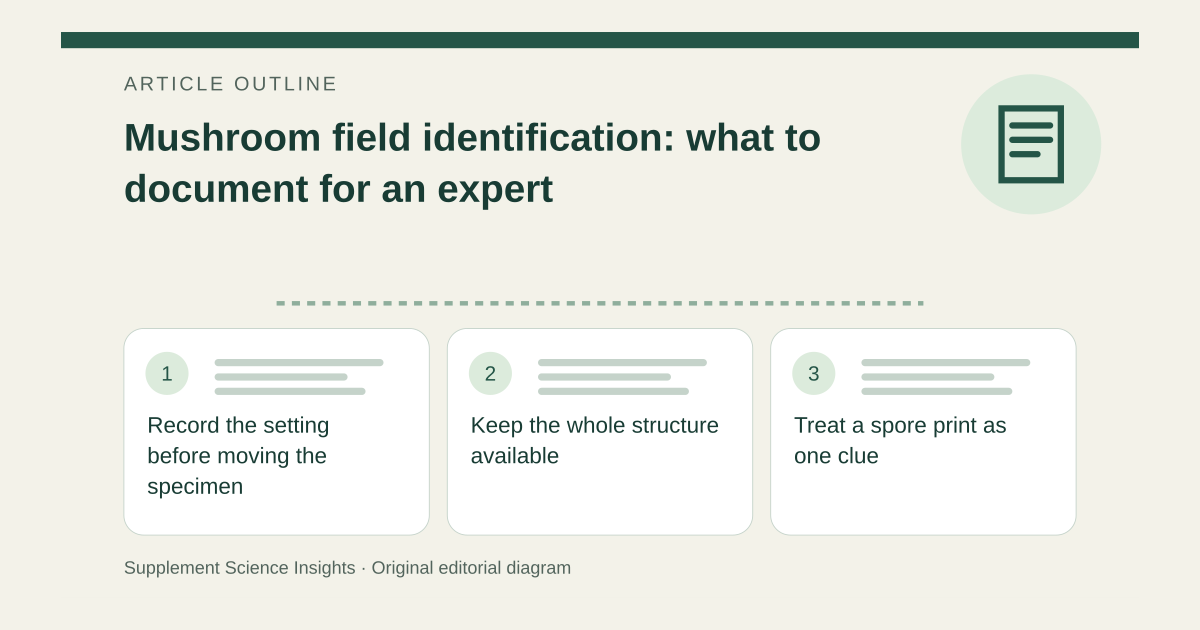
Record the setting before moving the specimen
Note the date, location, surface it grows from and nearby trees. Record whether mushrooms grow singly or in clusters. Montana State University Extension includes these details because the same general appearance can occur in different ecological settings. [1]
Keep the whole structure available
Where collection is permitted and an expert requests a specimen, preserve the cap, underside, stem and entire base. Photographs should show these features as well as the original setting. A cut-off stem or crushed sample may remove information needed for identification. Follow the receiving expert’s collection instructions. [1]
Treat a spore print as one clue
Spore color can contribute to identification. It must be interpreted with the rest of the specimen and habitat; it is not an edible-or-poisonous test. Local mycological teaching and qualified assessment are more useful than relying on a single matching image. [1][2]
Learning is different from clearing a meal
Keep unidentified specimens out of food. NC Poison Control advises trained expert identification and warns that cooking does not eliminate all mushroom toxins. If someone may have eaten an unknown mushroom, seek poison advice immediately rather than waiting for an ordinary identification appointment. In the United States call 1-800-222-1222. [2]
Make the question clear
Imagine sending a photograph of a cap without its underside or growing location. The expert may need more information. A record of the complete specimen and habitat supports a better assessment, but collecting more clues yourself does not turn uncertainty into permission to eat it. [1][2]
| Record | Purpose |
|---|---|
| Place, date and substrate | Ecological context |
| Cap, underside, stem and base | Preserve structural information |
| Reason for inquiry | Separate curiosity from an urgent exposure |
Sources for this article
- Collecting fungi and mushrooms for identification by the Schutter Diagnostic Laboratory
Source consulted: 2026-09-21. This is a reference resource, not a claim that we conducted the studies or tested a product. - Mushrooms
Source consulted: 2026-09-21. This is a reference resource, not a claim that we conducted the studies or tested a product.