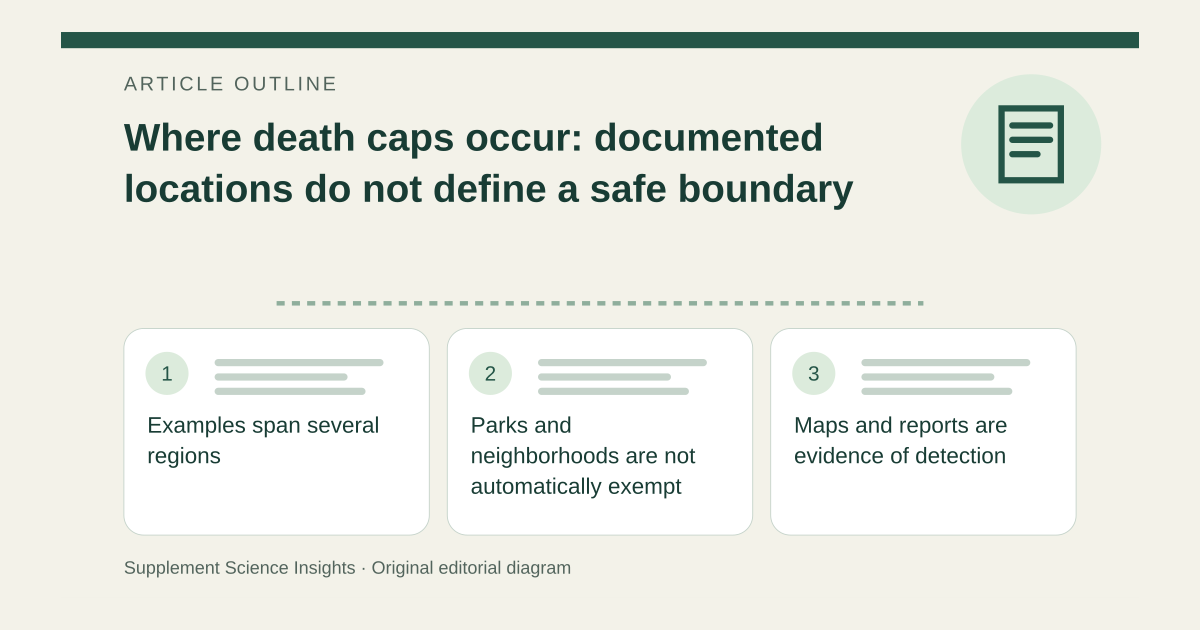
Examples span several regions
HUS documents Amanita phalloides in parts of southwestern Finland. BCCDC has issued warnings for southwestern British Columbia. Idaho public health reported a DNA-confirmed specimen in Boise, and NSW authorities reported detections in Sydney, the Southern Highlands and southern NSW. These examples demonstrate a broad distribution; they are not a complete country list. [1][2][3][4]
Parks and neighborhoods are not automatically exempt
The Boise record was associated with an oak in an established neighborhood. NSW guidance also warns about mushrooms around trees in parks and home gardens. A cultivated or urban setting does not establish that a mushroom is an ordinary edible variety. [3][4]
Maps and reports are evidence of detection
A recorded location shows where a specimen was found and recognized. It does not show every location where the fungus might occur, and the cited reports come from different years. For current local advice, consult regional public-health or mycological experts rather than treating this overview as a real-time distribution map. [3][5]
Location cannot clear a mushroom for eating
Imagine a mushroom resembles one eaten safely in another country. Local species and lookalikes can differ. Use expert identification and seek immediate poison advice after an uncertain ingestion; geography is not a substitute for those steps. [6][5]
| Observation | What it means |
|---|---|
| Confirmed local record | Presence was documented |
| No record found | Absence is not established |
| Urban tree setting | Not automatically safe |
| Familiar appearance abroad | Local identity still unresolved |
Sources for this article
- The most poisonous mushrooms in Finland | HUS
Source consulted: 2026-09-21. This is a reference resource, not a claim that we conducted the studies or tested a product. - Be on the lookout for poisonous death cap mushrooms in southwestern B.C.
Source consulted: 2026-09-21. This is a reference resource, not a claim that we conducted the studies or tested a product. - Highly poisonous death cap mushroom identified in Boise | Idaho Department of Health and Welfare
Source consulted: 2026-09-21. This is a reference resource, not a claim that we conducted the studies or tested a product. - Death cap mushroom detections prompt health warning | NSW Government
Source consulted: 2026-09-21. This is a reference resource, not a claim that we conducted the studies or tested a product. - Collecting fungi and mushrooms for identification by the Schutter Diagnostic Laboratory
Source consulted: 2026-09-21. This is a reference resource, not a claim that we conducted the studies or tested a product. - Mushrooms
Source consulted: 2026-09-21. This is a reference resource, not a claim that we conducted the studies or tested a product.