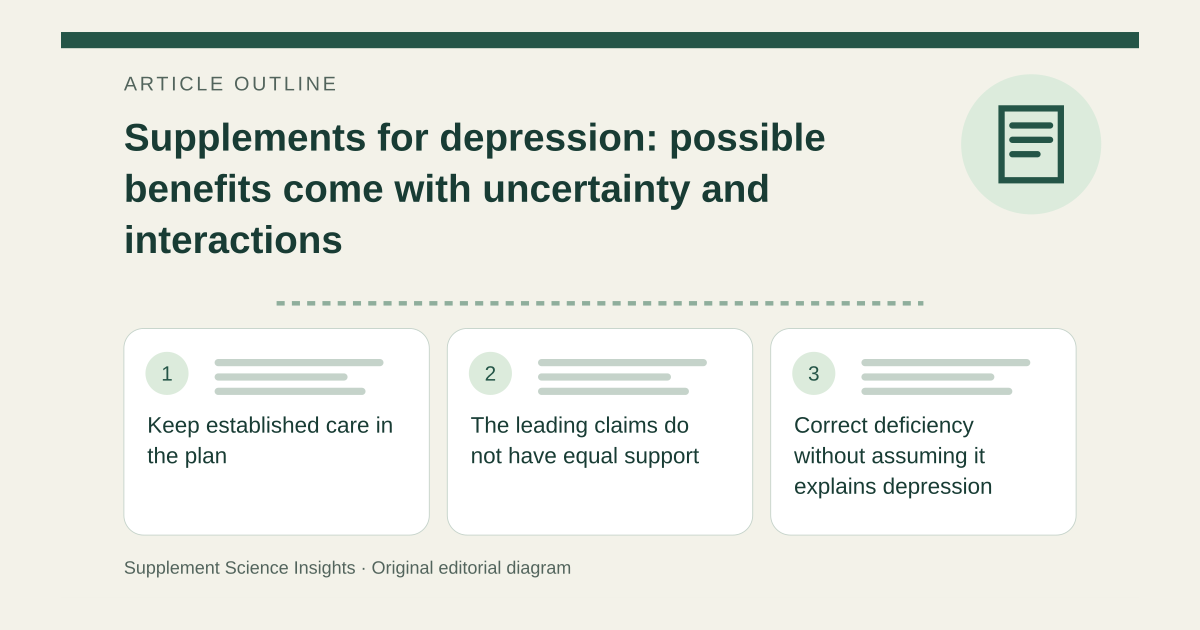
Keep established care in the plan
NCCIH advises against replacing conventional depression care or delaying assessment with a complementary approach. Depression can be serious, and the decision includes severity, previous response and current treatment rather than the supplement ingredient alone. [1]
The leading claims do not have equal support
NCCIH describes omega-3 benefit for depressive symptoms as uncertain. Findings for St John’s wort are mixed, with important drug-interaction concerns. Its summary does not support SAMe or inositol as established depression treatments. A promising adjunct finding does not mean the same product works alone. [1]
Correct deficiency without assuming it explains depression
Nutrient deficiency can require treatment, but a nutritional role is not proof that extra vitamins improve mood when intake is adequate. Review symptoms and the reason for testing or replacement with the clinician. Avoid combining several mood products without checking their ingredients and medicines. [2][3]
Review a proposed add-on before starting it
Imagine someone taking an antidepressant wants to add St John’s wort. The immediate question is interaction safety, not which bottle has the strongest extract. Bring the exact product to the prescriber or pharmacist and agree how any change will be assessed. [1][3]
| Option or finding | Practical implication |
|---|---|
| Omega-3 | Depression benefit remains uncertain |
| St John’s wort | Mixed evidence and substantial interaction concern |
| Nutrient deficiency | Treat the identified deficiency |
Sources for this article
- 8 Things To Know About Depression and Complementary Health Approaches | NCCIH
Source consulted: 2026-09-20. This is a reference resource, not a claim that we conducted the studies or tested a product. - Vitamin B12 - Health Professional Fact Sheet
Source consulted: 2026-09-20. This is a reference resource, not a claim that we conducted the studies or tested a product. - Dietary Supplements: What You Need to Know
Source consulted: 2026-09-20. This is a reference resource, not a claim that we conducted the studies or tested a product.