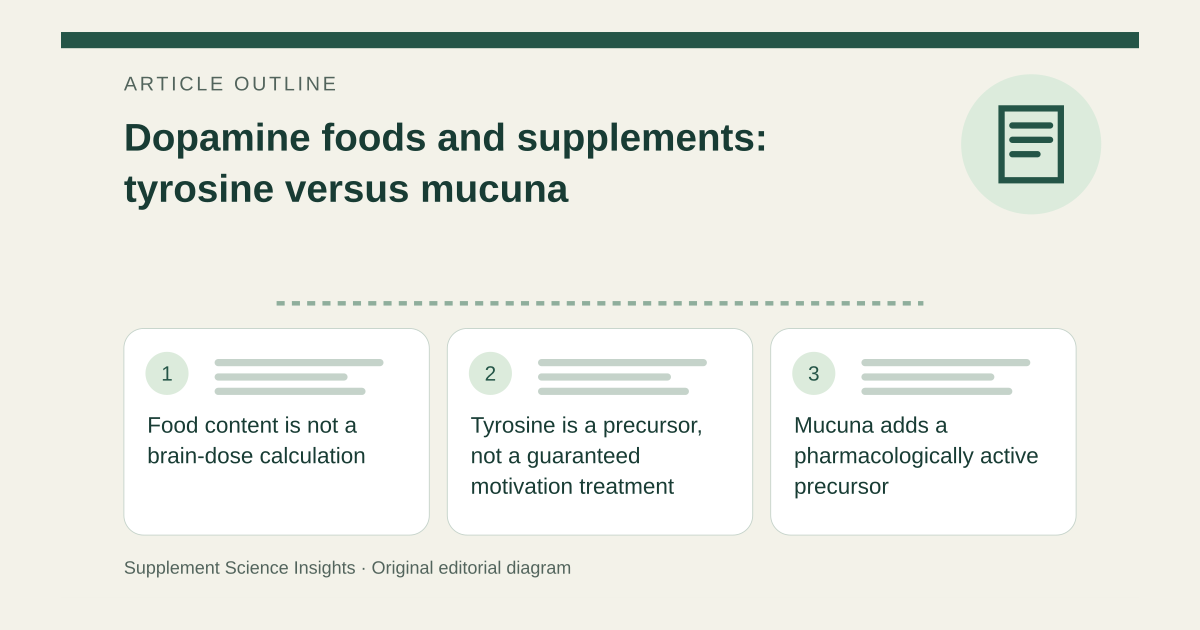
Food content is not a brain-dose calculation
A narrative review reports dopamine in foods including bananas, plantains and avocados, while emphasizing uncertain bioavailability and clinical implications. Plant part, ripeness and processing affect measurements. Eating such foods does not establish a predictable treatment effect on brain dopamine or mood. [1]
Tyrosine is a precursor, not a guaranteed motivation treatment
Protein-containing foods supply amino acids used in neurotransmitter pathways. Cleveland Clinic discusses tyrosine’s role but notes that dietary effects on neurotransmitters need more research. That biochemical role does not identify an ideal supplement dose or show that persistent low motivation is a dopamine deficiency. [2]
Mucuna adds a pharmacologically active precursor
Mucuna products can contain L-DOPA, the precursor used in Parkinson’s therapy. It carries a different risk profile from ordinary protein food. A small four-product laboratory study found some discrepancies between labeled and measured L-DOPA, and cannot establish safety or benefit for general wellness. [3][4]
Choose a health goal rather than a higher-neurotransmitter target
Imagine low energy prompts a ranking of tyrosine and mucuna. Assess sleep, symptoms, medicines and possible health conditions instead. Enjoyable activity and balanced nutrition can support well-being without claiming a measured dopamine increase or replacing treatment for a diagnosed disorder. [2][5]
| Claim or situation | Interpretation |
|---|---|
| Dopamine in fruit | Not a predictable brain dose |
| Tyrosine | Precursor role is not outcome proof |
| Mucuna | L-DOPA activity and product variability |
| Low motivation | Not a stand-alone deficiency diagnosis |
Sources for this article
- Dietary Neurotransmitters: A Narrative Review on Current Knowledge - PMC
Source consulted: 2026-09-21. This is a reference resource, not a claim that we conducted the studies or tested a product. - Dopamine: What It Is, Function & Symptoms
Source consulted: 2026-09-21. This is a reference resource, not a claim that we conducted the studies or tested a product. - Levodopa and Carbidopa: MedlinePlus Drug Information
Source consulted: 2026-09-21. This is a reference resource, not a claim that we conducted the studies or tested a product. - Quality assessment of “naturally occurring” high-percentage L-dopa commercial products proposed as dietary supplements on the Internet: from labeling to analytical findings - PMC
Source consulted: 2026-09-21. This is a reference resource, not a claim that we conducted the studies or tested a product. - Dietary Supplements: What You Need to Know - Consumer
Source consulted: 2026-09-21. This is a reference resource, not a claim that we conducted the studies or tested a product.