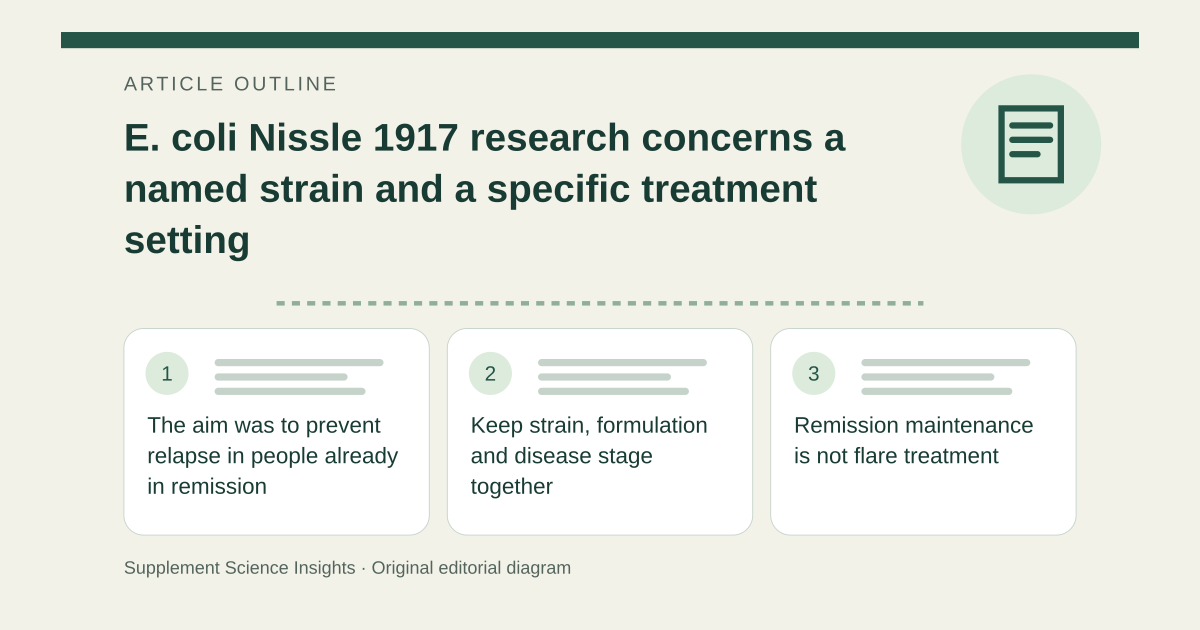
The aim was to prevent relapse in people already in remission
The study randomized 327 people to a Nissle 1917 preparation or mesalazine in a double-blind, double-dummy design for 12 months. Its primary aim was to test equivalence for maintenance of remission. [1]
In the per-protocol population, relapse occurred in 40 of 110 probiotic recipients and 38 of 112 mesalazine recipients. The authors reported equivalence under the study’s specified framework; this is not a finding that all possible E. coli products work equally well. [1]
Keep strain, formulation and disease stage together
The per-protocol analysis excluded a substantial number of randomized participants, an important design detail when interpreting the result. Two authors had affiliations with Ardeypharm, the company associated with the preparation. [1]
This older trial addresses a specific maintenance strategy, not current individualized treatment selection or every E. coli strain. It does not authorize using an unidentified bacterium or discontinuing anti-inflammatory treatment without the treating clinician’s plan. [1]
Remission maintenance is not flare treatment
Imagine a study enrolls people whose disease is already controlled. Preventing relapse in that group does not establish the same intervention’s ability to bring an active flare under control.
| Detail | Interpretation |
|---|---|
| Nissle 1917 | Specific strain |
| Already in remission | Study setting |
| Equivalent within trial framework | Not universal interchangeability |
Sources for this article
- Maintaining remission of ulcerative colitis with the probiotic Escherichia coli Nissle 1917 is as effective as with standard mesalazine - PMC
Source consulted: 2026-09-19. This is a reference resource, not a claim that we conducted the studies or tested a product.