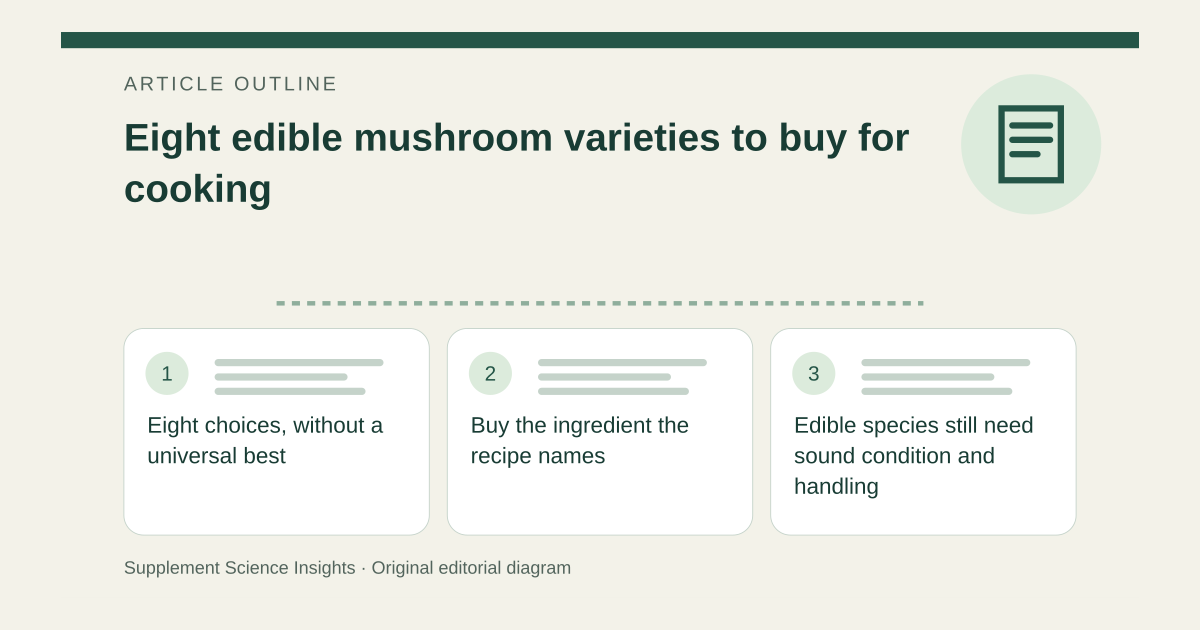
Eight choices, without a universal best
The Mushroom Council lists white button, crimini, portabella, shiitake, oyster, beech, maitake and king trumpet among its culinary varieties. Choose according to the recipe, availability and your preferences. These names describe food options, not a ranking of medical benefits or a guarantee that every person will tolerate every mushroom. [1]
Buy the ingredient the recipe names
Keep the supplier’s identity and preparation directions with the food. A common name on an unidentified wild specimen is not equivalent to a labeled culinary ingredient. If the intended variety is unavailable, use a recipe that specifically accommodates your substitute rather than guessing at wild look-alikes. [1][2]
Edible species still need sound condition and handling
Select fresh mushrooms without abnormal odor, slime or suspicious deterioration, and refrigerate promptly. A recognized food variety can spoil. Conversely, an attractive, fresh-looking wild mushroom can be toxic: freshness and species identity are separate checks. [3][2]
Choose for dinner, not for remote identification
Imagine comparing labeled shiitake and oyster mushrooms for a recipe. Either may be an appropriate culinary purchase when the recipe and handling instructions fit. A mushroom found beside a trail remains an identification question even if its photograph resembles one of those packages. [1][2]
| Situation | Decision basis |
|---|---|
| Labeled culinary variety | Recipe, condition and handling |
| Unknown outdoor specimen | Qualified identification, not resemblance |
| Slime or abnormal odor | Reject suspect food |
Sources for this article
- Mushroom Varieties | Mushrooms 101
Source consulted: 2026-09-21. This is a reference resource, not a claim that we conducted the studies or tested a product. - Mushrooms
Source consulted: 2026-09-21. This is a reference resource, not a claim that we conducted the studies or tested a product. - Proper Handling of Fresh Mushrooms
Source consulted: 2026-09-21. This is a reference resource, not a claim that we conducted the studies or tested a product.