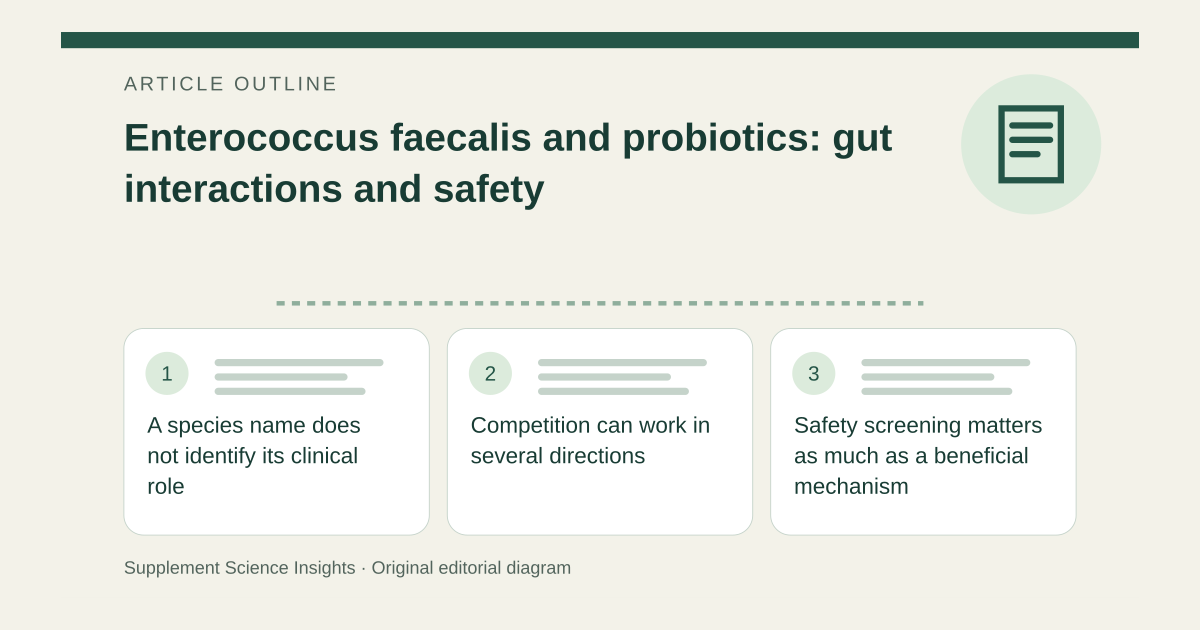
A species name does not identify its clinical role
The reviewed literature describes enterococci as both gut-associated organisms and opportunistic pathogens. Strains differ in virulence and antibiotic-resistance characteristics. Finding a species name on a microbiome report is therefore not enough to diagnose infection or select a treatment. [1]
Competition can work in several directions
Microbes compete for resources and ecological niches. Some enterococci produce bacteriocins that inhibit other bacteria, while other microbial products may inhibit enterococci under experimental conditions. Such interactions are strain- and setting-dependent, not a predictable retail-capsule method for controlling E. faecalis. [1][2]
Safety screening matters as much as a beneficial mechanism
Potentially useful strains require careful assessment for virulence and acquired resistance. Evidence involving E. faecium cannot simply be transferred to E. faecalis, or from one named strain to another. Severe illness and impaired immunity require particular caution with live microbial products. [1][3]
Do not treat a report instead of the person
Imagine a stool report lists E. faecalis and someone buys a probiotic to remove it. The report alone does not establish a disease requiring eradication. A diagnosed infection needs appropriate clinical testing and treatment; probiotic competition is not a substitute. [1][4]
| Detail | Why it matters |
|---|---|
| Species | Not a strain-level safety profile |
| Colonization | Different from clinical infection |
| Laboratory inhibition | Not proven human eradication |
| Virulence and resistance | Central safety considerations |
Sources for this article
- The Genus Enterococcus: Between Probiotic Potential and Safety Concerns—An Update - PMC
Source consulted: 2026-09-21. This is a reference resource, not a claim that we conducted the studies or tested a product. - Interplay between gut microbiota and antimicrobial peptides - PMC
Source consulted: 2026-09-21. This is a reference resource, not a claim that we conducted the studies or tested a product. - Probiotics - Health Professional Fact Sheet
Source consulted: 2026-09-21. This is a reference resource, not a claim that we conducted the studies or tested a product. - Probiotics: Usefulness and Safety | NCCIH
Source consulted: 2026-09-21. This is a reference resource, not a claim that we conducted the studies or tested a product.