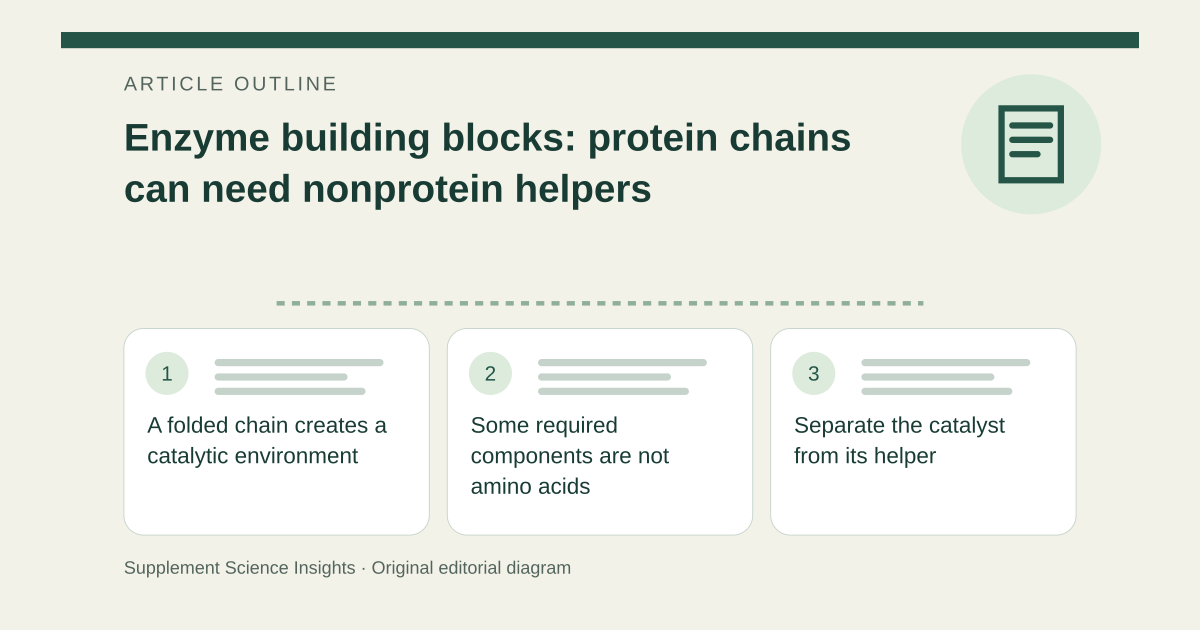
A folded chain creates a catalytic environment
During protein synthesis, a ribosome reads the messenger-RNA template while transfer RNAs supply amino acids for the growing chain. Those amino acids become residues linked by peptide bonds. Digestive protein enzymes are built from amino acids too; their folded sequence enables a catalytic function rather than making them a separate class of building material. [1][2]
OpenStax describes enzymes as catalysts that lower the activation-energy barrier of reactions. In protein enzymes, the arrangement of amino-acid residues creates an active site suited to particular substrates. [1][2]
The chain’s composition alone is insufficient to describe activity: the residues must form an appropriate structure and chemical environment. Simply consuming the component amino acids does not reproduce the assembled enzyme. [1][2]
Some required components are not amino acids
Many enzymes require inorganic ions or organic coenzymes. Some vitamins serve as coenzymes or their precursors, which helps explain a connection between nutrient availability and enzyme function. [1]
A vitamin is not therefore the same thing as an enzyme, and a required cofactor does not mean more of it always increases useful activity. The word most also matters: the protein-enzyme model should not be stated as an exceptionless definition of every biological catalyst. [1]
Separate the catalyst from its helper
Imagine an enzyme needs a metal ion to function. Listing the amino-acid sequence describes its protein component, while naming the metal adds another requirement. Neither component alone is an adequate description of the working system.
| Detail | Interpretation |
|---|---|
| Protein chain | Provides the catalytic structure |
| Cofactor/coenzyme | May be required for activity |
| Dietary supplement | Not the assembled enzyme |
Sources for this article
- 6.5 Enzymes - Biology 2e | OpenStax
Source consulted: 2026-09-17. This is a reference resource, not a claim that we conducted the studies or tested a product. - OpenStax Biology 2e: Ribosomes and Protein Synthesis
Source consulted: 2026-09-20. This is a reference resource, not a claim that we conducted the studies or tested a product.