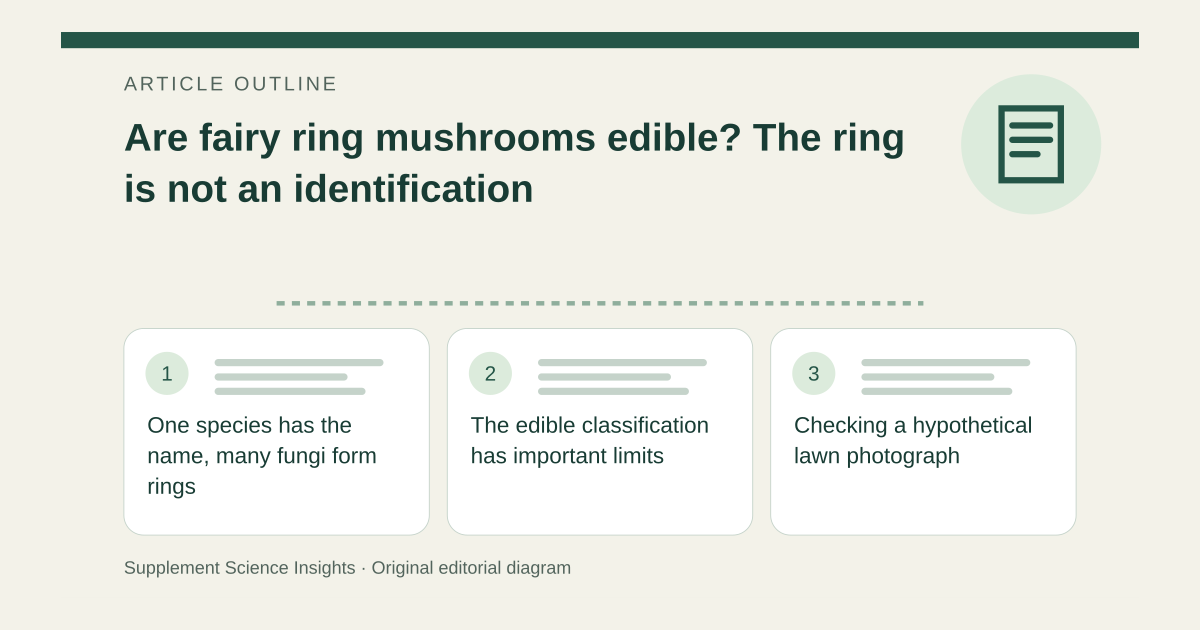
One species has the name, many fungi form rings
The Missouri Department of Conservation lists Marasmius oreades as the fairy ring mushroom. A fairy ring also describes a growth pattern: underground mycelium expands outward, and mushrooms appear near its active edge. University of Minnesota Extension describes rings in lawns more generally. Finding a circle therefore does not identify every mushroom in it as Marasmius oreades. [1][2]
The edible classification has important limits
Missouri’s guide considers Marasmius oreades edible with caution and lists poisonous Clitocybe and Inocybe lookalikes. A lawn location, tan cap or circular pattern is insufficient to distinguish these organisms reliably. The guide’s status applies to a correctly identified species, not to an unknown specimen that happens to share its common description. Do not eat a found mushroom without trained expert identification. [1]
Checking a hypothetical lawn photograph
A photograph captioned “fairy ring” establishes a visible pattern. Changing the caption to “edible fairy ring mushrooms” adds a species and safety claim that the pattern alone does not support. Keep those claims separate when documenting a lawn observation or asking an expert for identification help. [2][1]
| Observation or name | What is established |
|---|---|
| Circular lawn growth | A fairy-ring pattern |
| Marasmius oreades | A specific named species |
| Edible status in a guide | Applies only after correct identification |
Sources for this article
- Fairy Ring Mushroom | Missouri Department of ConservationmorelMorelmorelmorel
Source consulted: 2026-09-20. This is a reference resource, not a claim that we conducted the studies or tested a product. - Mushrooms in lawns | UMN Extension
Source consulted: 2026-09-20. This is a reference resource, not a claim that we conducted the studies or tested a product.