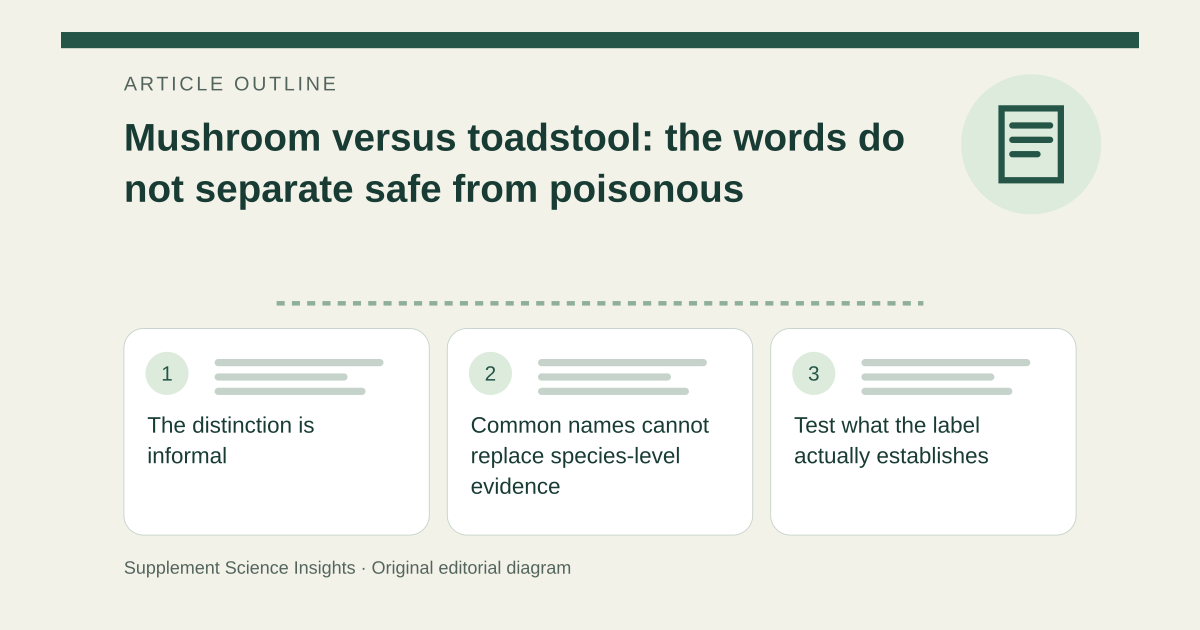
The distinction is informal
Toadstool often brings to mind a cap on a stalk and has sometimes been associated with poisonous or inedible fungi. RHS explains that this usage is not a universally accepted definition. [1]
Mushroom can describe similar fruiting bodies and can also be used more broadly. Seeing that word in an article does not establish that the species is edible. [1]
Common names cannot replace species-level evidence
Shape, color, gills and pores vary among fungal fruiting bodies. These features can contribute to identification, but the choice between two ordinary words does not certify safety. [1]
This terminology explanation is not a foraging guide or a judgment about a particular specimen. When evaluating an ingredient or a food claim, seek a clear identity and evidence for the actual material. A reassuring common name cannot resolve uncertainty about an unknown organism. [1]
Test what the label actually establishes
Imagine two writers describe the same specimen using different everyday words. The organism’s chemistry has not changed because one writer chose mushroom and the other chose toadstool; the name alone cannot settle whether it is edible.
| Detail | Interpretation |
|---|---|
| Mushroom | Broad everyday term |
| Toadstool | Informal overlapping term |
| Edibility | Requires separate evidence |
Sources for this article
- Toadstools in Gardens | RHS Advice
Source consulted: 2026-09-19. This is a reference resource, not a claim that we conducted the studies or tested a product.