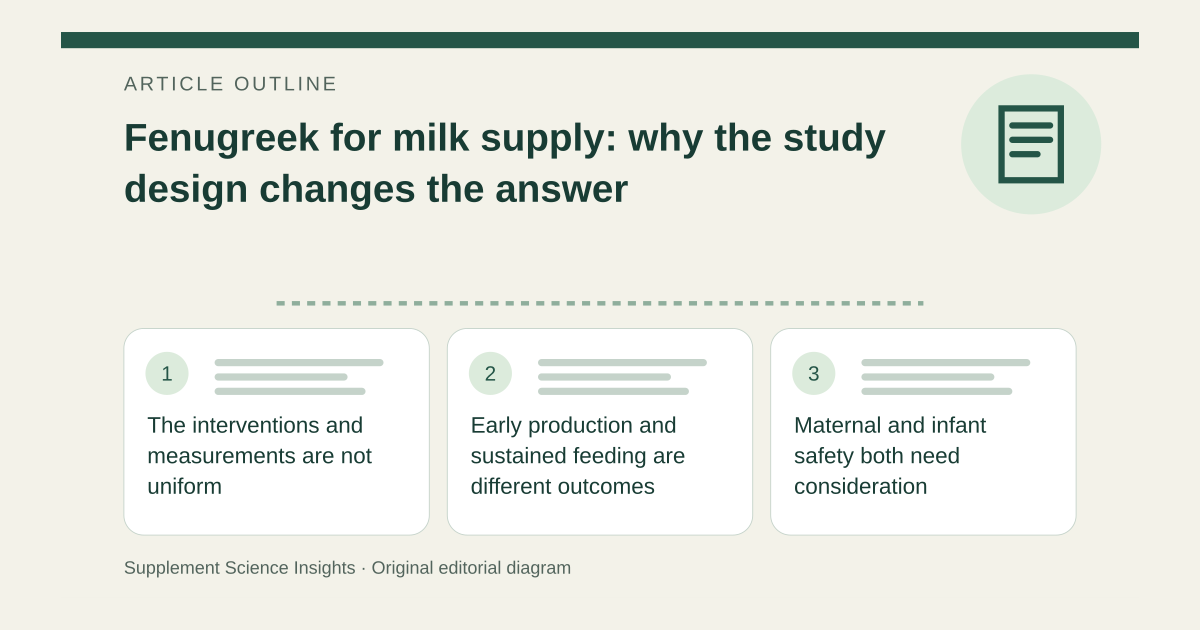
The interventions and measurements are not uniform
LactMed describes a placebo-controlled trial in mothers of very preterm infants that found no significant difference in milk volume or prolactin in the analyzed groups. More than half of those initially randomized did not complete it, and there was no intention-to-treat analysis. Attrition limits how confidently the result can be generalized. [1][2]
Another study involved 66 postpartum mothers and a tea with several herbs, including fenugreek. Early pumped volume and some infant weight measures favored the tea, but no long-term outcomes were collected. That design cannot isolate fenugreek as the responsible ingredient. [1][2]
Early production and sustained feeding are different outcomes
The timing of an intervention matters because milk production changes after birth. A measurement on the third postpartum day does not establish an effect weeks later. Pumped volume, milk transferred during feeding and infant growth also answer related but different questions. [1][2]
LactMed reports conflicting review conclusions and emphasizes that galactagogues should not replace evaluation and counseling about modifiable feeding factors. NCCIH similarly considers the evidence uncertain. These are authoritative summaries, not independent trial appraisals conducted for this article. [1][2]
Maternal and infant safety both need consideration
Digestive symptoms and allergic reactions can occur in the parent, and safety information during breastfeeding remains limited. A preparation used in a small study does not establish that all commercial blends are equivalent or that direct infant administration is safe. [1][2]
For suspected low supply, obtain feeding assessment and infant-growth review. A supplement should not delay investigation of inadequate intake or feeding difficulties. [1][2]
Keep a mixed product’s result attached to the mixture
Imagine a tea containing seven herbs is associated with increased early pumped volume. Calling that proof that fenugreek alone raises long-term supply removes both the other ingredients and the timing limitation.
| Question | Relevant distinction |
|---|---|
| Early pumped volume | A time-specific outcome |
| Multi-herb tea | Cannot isolate one ingredient |
| Feeding assessment | Addresses modifiable causes |
Sources for this article
- LactMed: Fenugreek
Source consulted: 2026-09-17. This is a reference resource, not a claim that we conducted the studies or tested a product. - NCCIH: Fenugreek
Source consulted: 2026-09-17. This is a reference resource, not a claim that we conducted the studies or tested a product.