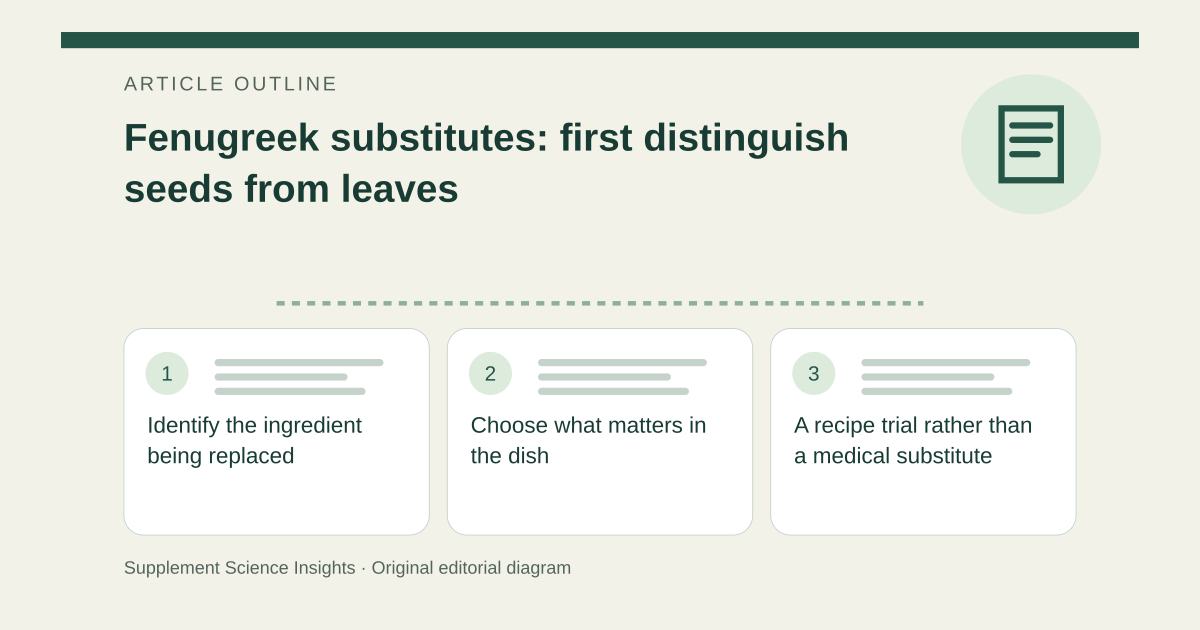
Identify the ingredient being replaced
Fenugreek is Trigonella foenum-graecum. Its seeds have a characteristic maple-like flavor described by NCCIH. A recipe asking for seeds, ground seed or leaves is specifying a different ingredient format. Fennel is a separate plant, so a similar-looking name is not proof of an equivalent substitution. [1][2]
Choose what matters in the dish
As a practical improvisation, decide whether you need a background spice, a leafy component or a particular aroma. For a nonessential small seed addition, omission may be preferable to an aggressive one-for-one replacement. If using a familiar spice blend, inspect all its ingredients and test a small portion; it changes more than the fenugreek component. [2]
A recipe trial rather than a medical substitute
Imagine a curry uses a small amount of ground fenugreek. Make a sample without it, then compare with a cautious alternative seasoning that already suits the dish. Record the change for next time. This does not reproduce a fenugreek supplement or its proposed effects, and culinary substitutions should not be used to recreate a treatment regimen. [1]
| Hypothetical recipe instruction | First question |
|---|---|
| Whole fenugreek seed | Is the seed texture essential? |
| Ground seed | How important is its distinct flavor? |
| Fenugreek leaves | Do not assume seed powder is equivalent |
Sources for this article
- Fenugreek: Usefulness and Safety | NCCIH
Source consulted: 2026-09-20. This is a reference resource, not a claim that we conducted the studies or tested a product. - ICAR-AICRP on Spices
Source consulted: 2026-09-20. This is a reference resource, not a claim that we conducted the studies or tested a product.