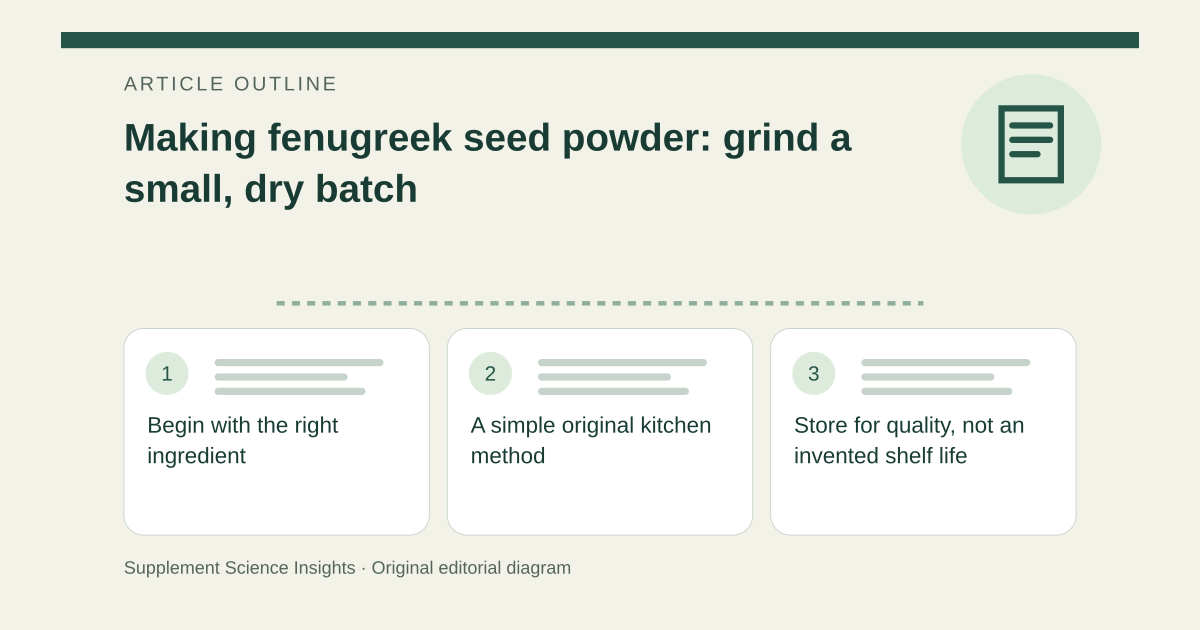
Begin with the right ingredient
Choose packaged culinary fenugreek seed, identified as Trigonella foenum-graecum, rather than an unidentified garden seed. Work with a small quantity and dry equipment. Grinding changes the ingredient’s size, not its identity or the evidence for medicinal effects. [1][2]
A simple original kitchen method
If your recipe calls for toasted seed, warm a small batch gently in a dry pan while stirring, stop before scorching and let it cool fully. Grind in short pulses, following the appliance instructions, and let dust settle before opening. Sieve if a finer texture is useful and regrind larger pieces. No specific time here guarantees pathogen destruction or validated preservation. [2]
Store for quality, not an invented shelf life
Transfer cooled powder to a clean, dry, tightly closed container, label the date and keep it cool and dark. Avoid steam and wet spoons. Imagine grinding enough for a few planned meals rather than processing a large jar whose flavor will fade after grinding. Discard material that becomes damp or visibly contaminated; reheating is not a reliable salvage step. [3][4]
| Hypothetical step | Purpose |
|---|---|
| Optional gentle toasting | Flavor adjustment, not a kill-step claim |
| Cool then grind | Prepare a dry powder |
| Small sealed batch | Reduce unnecessary quality loss |
Sources for this article
- ICAR-AICRP on Spices
Source consulted: 2026-09-20. This is a reference resource, not a claim that we conducted the studies or tested a product. - Fenugreek: Usefulness and Safety | NCCIH
Source consulted: 2026-09-20. This is a reference resource, not a claim that we conducted the studies or tested a product. - Storing Herbs and Spices — UC Cooperative Extension
Source consulted: 2026-09-20. This is a reference resource, not a claim that we conducted the studies or tested a product. - Food Storage Conditions — Utah State University Extension
Source consulted: 2026-09-20. This is a reference resource, not a claim that we conducted the studies or tested a product.