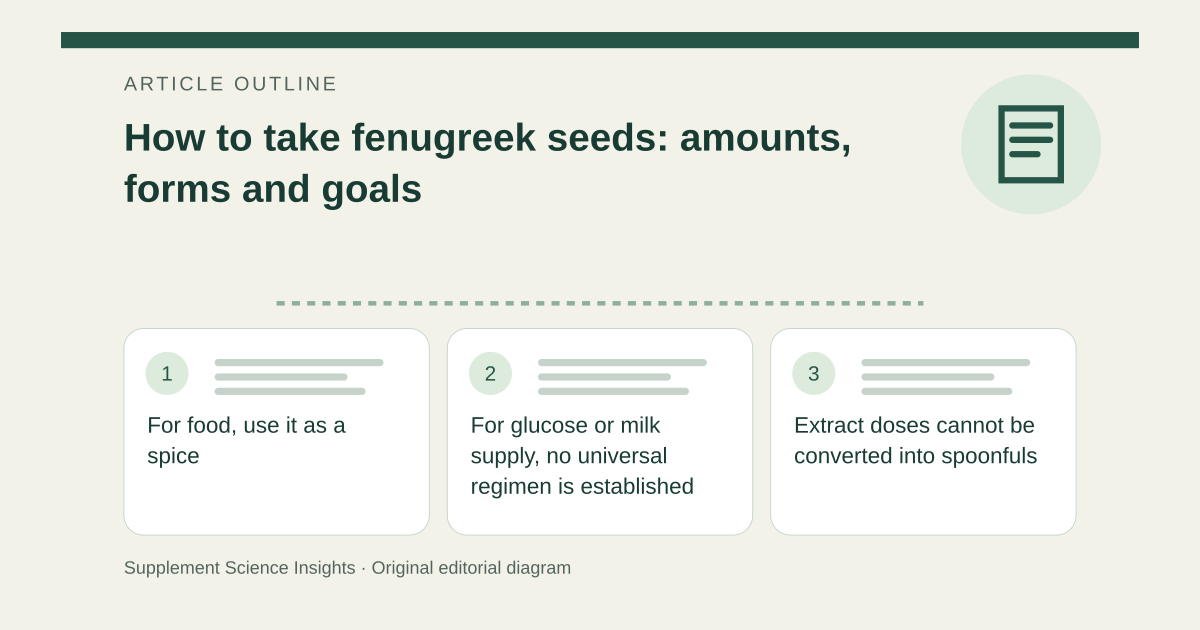
For food, use it as a spice
Seeds may be ground into dishes or used in an infusion; these are food preparations, not standardized treatments. Begin with a small culinary quantity suited to the recipe and tolerance. There is no established daily seed requirement or need to swallow large amounts for general health. [1][2]
For glucose or milk supply, no universal regimen is established
NCCIH reports possible glucose lowering with limited study quality and mixed findings for milk supply. These data do not establish a standard seed dose for self-treatment. Glucose-lowering medicines and breastfeeding circumstances make individualized professional advice particularly relevant. [1]
Extract doses cannot be converted into spoonfuls
Male-hormone studies summarized in a recent review often used specific extracts around 500 to 600 mg daily, with very uncertain evidence. That amount is not equivalent to whole seed powder. EMA recognizes traditional preparations for temporary appetite loss and minor skin inflammation, while explicitly distinguishing traditional use from clinical proof. [3][2]
Practical use starts with the form and safety
Imagine a label lists both extract milligrams and a much larger seed-equivalent amount. Record which quantity is actually swallowed rather than adding both. Avoid medicinal amounts during pregnancy; review allergy, medicines and digestive reactions before repeated use. [4][1]
| Goal | Dose conclusion |
|---|---|
| Cooking | Recipe quantity, not a medical dose |
| Blood glucose | No universal self-treatment regimen |
| Milk supply | Mixed evidence; individual assessment |
| Testosterone | Specific extract studies, very uncertain benefit |
Sources for this article
- Fenugreek: Usefulness and Safety | NCCIH
Source consulted: 2026-09-21. This is a reference resource, not a claim that we conducted the studies or tested a product. - Trigonellae foenugraeci semen - herbal medicinal product | European Medicines Agency (EMA)
Source consulted: 2026-09-21. This is a reference resource, not a claim that we conducted the studies or tested a product. - Frontiers | Effects of oral fenugreek-derived preparations on testosterone-related outcomes in adult men: a systematic review and meta-analysis of randomized placebo-controlled trials
Source consulted: 2026-09-21. This is a reference resource, not a claim that we conducted the studies or tested a product. - Dietary Supplements: What You Need to Know
Source consulted: 2026-09-21. This is a reference resource, not a claim that we conducted the studies or tested a product.