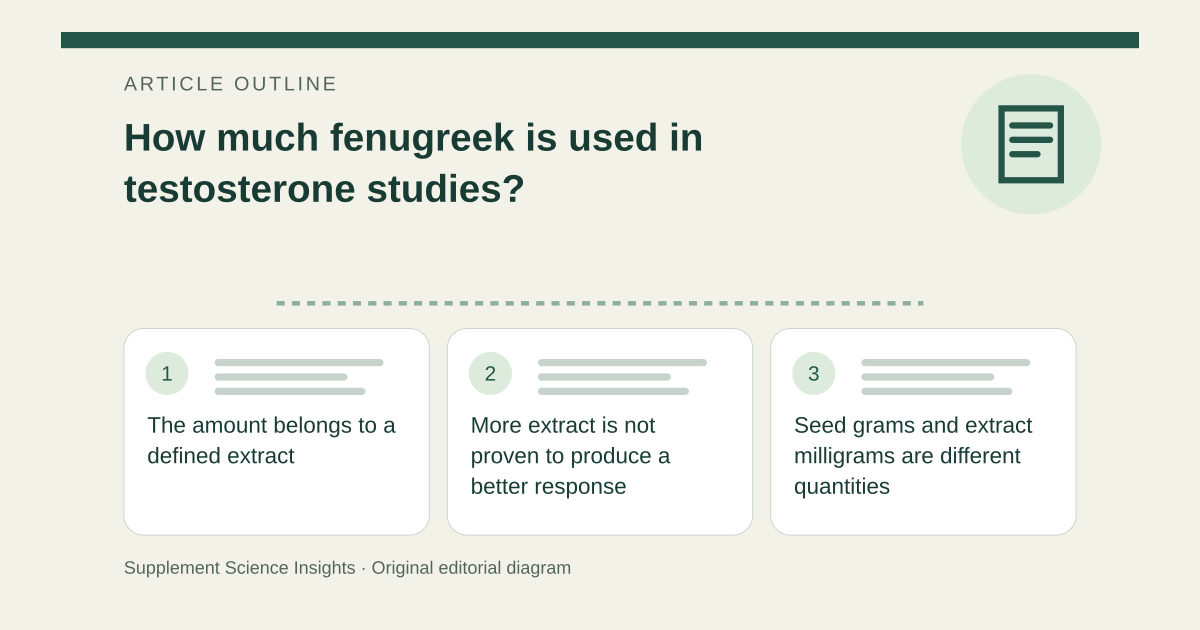
The amount belongs to a defined extract
The 2026 male-trial review lists several proprietary preparations around 500 to 600 mg daily, often studied for eight to twelve weeks. Their composition and standardization differ. These ranges describe research, not an optimal personal dose. [1]
More extract is not proven to produce a better response
The review did not establish a dependable dose-response relationship. A small pooled total-testosterone signal and an unstable free-testosterone result cannot justify dose escalation. Some findings also depended on which studies were included. [1]
Seed grams and extract milligrams are different quantities
A spoonful of seed contains a different mixture from a concentrated preparation. A label claiming an equivalent amount of raw herb does not establish equivalence to the tested extract or to its hormone results. Check the actual ingredient and serving amount. [2][1]
Suspected deficiency needs diagnosis
Imagine a low afternoon testosterone result leads to a high-dose supplement plan. Clinical assessment uses symptoms and appropriate repeat morning testing; a single result does not establish a treatment need. Review risks and medicines rather than choosing a dose from a marketing claim. [3][4]
| Quantity | Meaning |
|---|---|
| 500–600 mg extract | Selected research preparations |
| Seed powder grams | Different material |
| Eight to twelve weeks | Study duration, not guaranteed benefit |
| Larger dose | No established greater response |
Sources for this article
- Frontiers | Effects of oral fenugreek-derived preparations on testosterone-related outcomes in adult men: a systematic review and meta-analysis of randomized placebo-controlled trials
Source consulted: 2026-09-21. This is a reference resource, not a claim that we conducted the studies or tested a product. - Dietary Supplements: What You Need to Know
Source consulted: 2026-09-21. This is a reference resource, not a claim that we conducted the studies or tested a product. - Hypogonadism in Men | Endocrine Society
Source consulted: 2026-09-21. This is a reference resource, not a claim that we conducted the studies or tested a product. - Fenugreek: Usefulness and Safety | NCCIH
Source consulted: 2026-09-21. This is a reference resource, not a claim that we conducted the studies or tested a product.