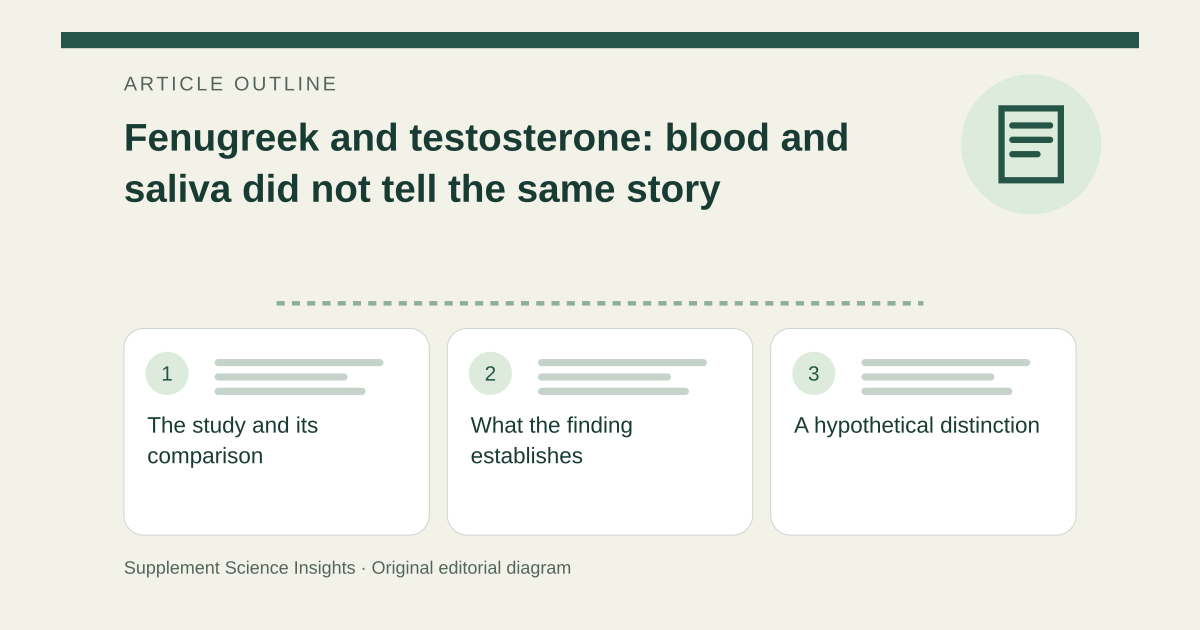
The study and its comparison
Ninety-five men completed a twelve-week blinded trial of different amounts of a fenugreek-containing preparation and essential nutrients, or control tablets. Researchers assessed plasma testosterone, a calculated free-testosterone index and saliva testosterone. [1]
Pooled active groups improved from baseline in plasma measures, but those comparisons were not significant versus placebo. Saliva testosterone did differ from placebo, with selected dose-level findings also reported. No subjective benefit was observed. [1]
What the finding establishes
Different biological samples and analyses cannot be combined into an uncomplicated testosterone-boosting claim. Multiple comparisons, a combined preparation and a completer count limit interpretation. Funding and complete conflicts were not established from the abstract. The result does not establish treatment of diagnosed hormone deficiency or a dose of culinary fenugreek seeds. [1]
A hypothetical distinction
Imagine a blood measure changes from baseline but not relative to control. A positive saliva comparison answers a different measurement question.
| Detail | Interpretation |
|---|---|
| Measured outcome | Keep the endpoint specific |
| Study preparation | Not every retail product |
| Remaining uncertainty | Not resolved by a mechanism |
Sources for this article
- Effect of a plant extract of fenugreek (Trigonella foenum-graecum) on testosterone in blood plasma and saliva in a double blind randomized controlled intervention study.
Source consulted: 2026-09-19. This is a reference resource, not a claim that we conducted the studies or tested a product.