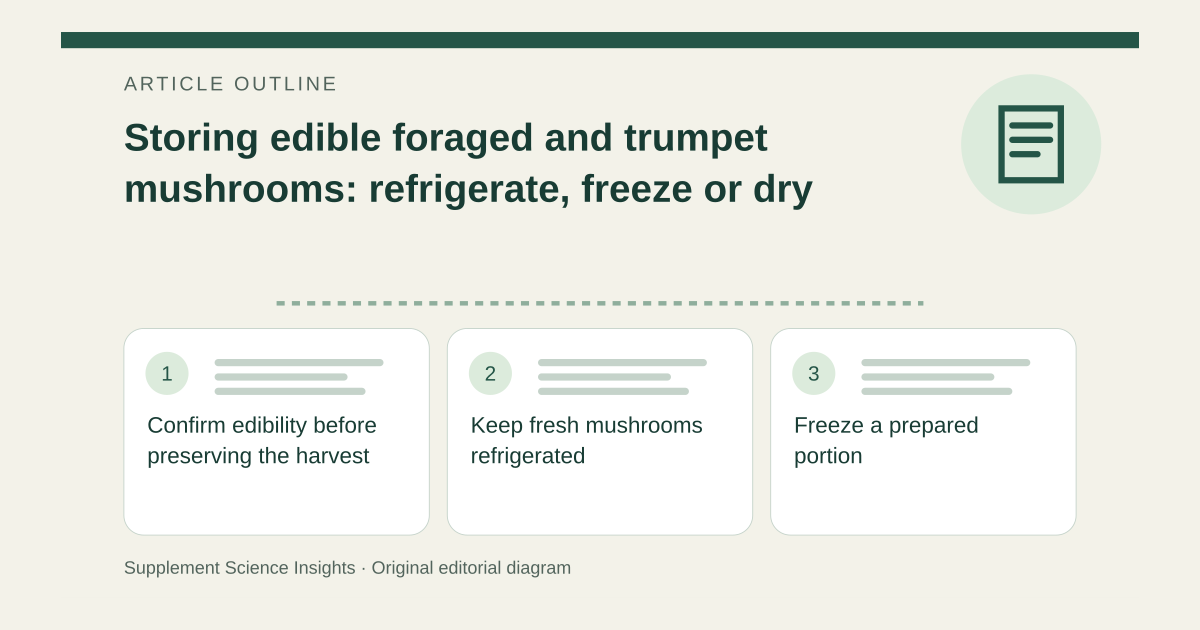
Confirm edibility before preserving the harvest
OSU advises expert identification and warns that cooking or drying does not destroy poisonous-mushroom toxins. A common name such as trumpet is not sufficient identification. Use reliably identified edible mushrooms, and do not mix uncertain specimens into a batch you plan to store. [1]
Keep fresh mushrooms refrigerated
Penn State recommends refrigeration in the original suitable container or a paper bag and gives a short three-day storage guide. Moisture trapped in a plastic bag can promote spoilage. Keep mushrooms separate from raw meat and household chemicals, and reject decayed or contaminated specimens instead of preserving them. [2]
Freeze a prepared portion
For many varieties, OSU recommends washing, cutting into serving pieces and sauteing in a little oil or butter until nearly done. Cool promptly, pack into freezer containers, seal, label and freeze. This is a food-preservation method, not a way to repair a spoiled or unidentified specimen. [1][3]
Dry to an endpoint, not a guessed deadline
OSU describes cleaning, trimming woody portions, cutting to approximately half-inch thickness and dehydrating at 120°F until crisp or brittle. Piece shape and thickness affect time. After cooling, keep thoroughly dried mushrooms protected from moisture; a damp center is not a finished shelf-storage product. [1]
Do not substitute wild mushrooms into a canning recipe
The cited preservation guidance limits home canning to suitable domestically grown button mushrooms. Wild or specialty trumpet mushrooms cannot simply inherit that process. Use the freezing or drying guidance appropriate to an identified edible species instead. [1]
Choose the portion you will actually use
Imagine a verified edible harvest exceeds this week’s meals. Refrigerate a small near-term portion and preserve the rest promptly. Label the species and preparation so a frozen cooked portion is not confused with fresh mushrooms or an unknown mixed harvest. [2][1]
| Storage route | Key condition |
|---|---|
| Refrigerator | Short storage; avoid trapped moisture |
| Freezer | Prepare, cool and package |
| Dehydrator | Reach the specified dry endpoint |
| Home canning | Do not use wild mushrooms |
Sources for this article
- Preserving mushrooms | OSU Extension Service
Source consulted: 2026-09-21. This is a reference resource, not a claim that we conducted the studies or tested a product. - Preparing and Preserving Mushrooms
Source consulted: 2026-09-21. This is a reference resource, not a claim that we conducted the studies or tested a product. - Freezing Mushrooms - National Center for Home Food Preservation
Source consulted: 2026-09-21. This is a reference resource, not a claim that we conducted the studies or tested a product.