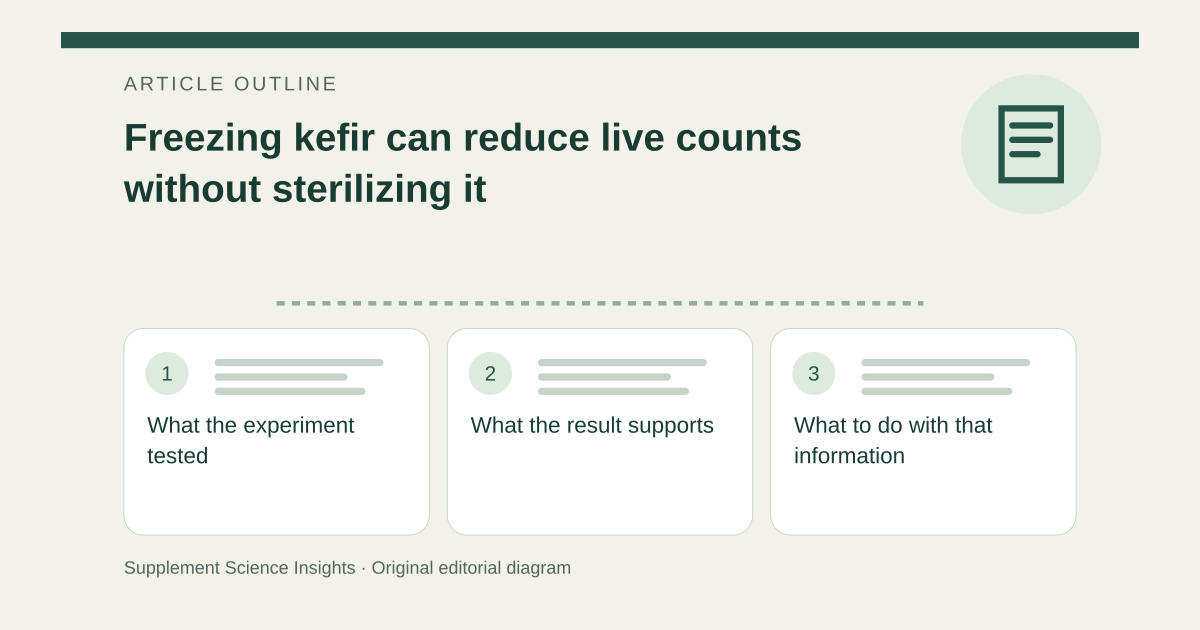
What the experiment tested
A 2016 food-microbiology study compared goat-milk kefir made with traditional grains or a commercial starter. Samples were frozen at −8 to −14°C and assessed at days 0, 7, 14 and 30. Researchers plated lactobacilli, lactococci and yeasts; this was not a human trial of digestion or another health outcome. [1]
What the result supports
Counts declined significantly during storage, while traditional kefir had higher counts at each sampling. The abstract does not provide an exact percentage loss or establish the number of independent production replicates. Funding and conflicts are not specified in the inspected record. The result is preparation-specific, not a universal survival guarantee. [1]
What to do with that information
Imagine freezing a retail kefir to avoid waste. Follow its storage guidance and understand that surviving organisms, texture and proven health effects are separate questions. Freezing is not a way to turn poorly handled food safe, and the study does not supply a guaranteed probiotic dose after thawing for an unrelated product. [2][3]
| Example | Interpretation |
|---|---|
| Reduced colony counts | Not proof of complete sterilization |
| Different retail formula | Survival may differ |
| Viability measurement | Not a measured human benefit |
Sources for this article
- Short communication: The effects of frozen storage on the survival of probiotic microorganisms found in traditionally and commercially manufactured kefir.
Source consulted: 2026-09-20. This is a reference resource, not a claim that we conducted the studies or tested a product. - Probiotics - Health Professional Fact Sheet
Source consulted: 2026-09-20. This is a reference resource, not a claim that we conducted the studies or tested a product. - Refrigeration and Food Safety
Source consulted: 2026-09-20. This is a reference resource, not a claim that we conducted the studies or tested a product.