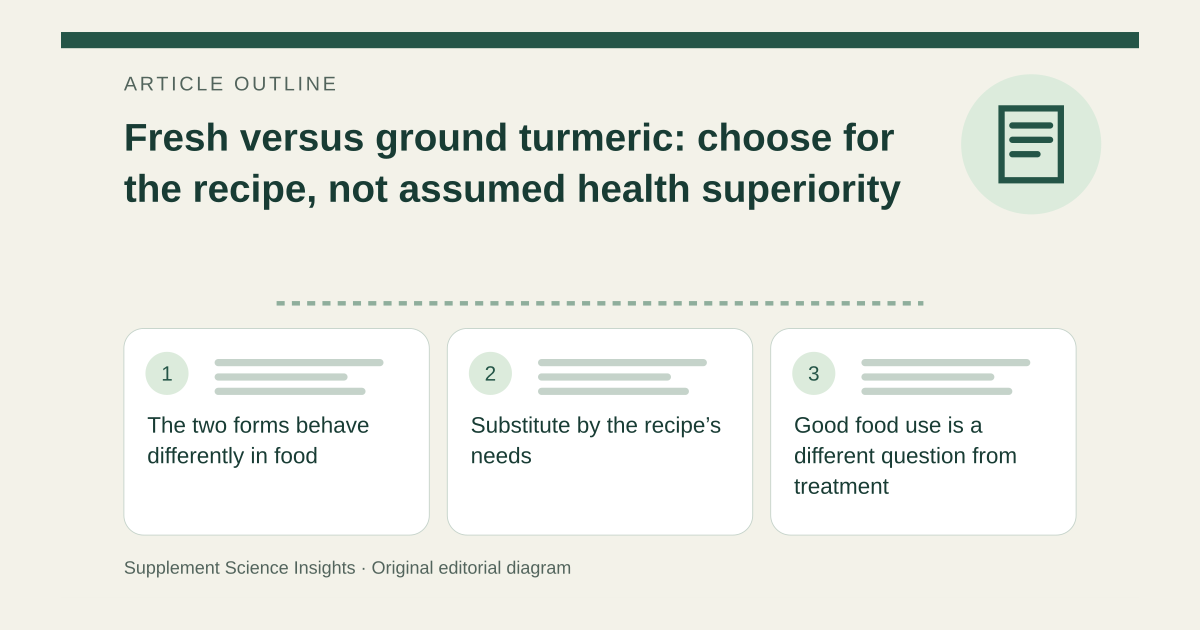
The two forms behave differently in food
Fresh rhizome can be grated or chopped into a dish. Ground turmeric disperses as a powder and does not bring the same moisture or pieces. Drying and grinding are processing steps, so equal spoonfuls are not a precise compositional match. [1][2]
Substitute by the recipe’s needs
A smooth dry seasoning blend generally calls for powder, while a paste may accommodate grated rhizome. Use the form specified when precision matters. If experimenting, adjust a small portion for taste and moisture instead of assuming a universal fresh-to-dried conversion reproduces every preparation. [2][3]
Good food use is a different question from treatment
Imagine fresh turmeric is advertised as inherently more effective because it looks less processed. That appearance does not establish clinical superiority over powder. NCCIH notes that turmeric research involves differing preparations, and food portions cannot simply be treated as interchangeable with concentrated study products. [4]
| Situation | Practical interpretation |
|---|---|
| Fresh rhizome | Moisture and texture |
| Ground powder | Convenient for dry blends |
| Therapeutic comparison | Needs evidence for the actual preparations |
Sources for this article
- Ginger and Turmeric: Tropical Superfoods for the Garden - Caldwell County Center | N.C. Cooperative Extension
Source consulted: 2026-09-20. This is a reference resource, not a claim that we conducted the studies or tested a product. - FSHN13-03/FS225: Shopping for Health: Herbs and Spices
Source consulted: 2026-09-20. This is a reference resource, not a claim that we conducted the studies or tested a product. - Make-Your-Own Seasoning Blends : Center for Agriculture, Food, and the Environment (CAFE) at UMass Amherst
Source consulted: 2026-09-20. This is a reference resource, not a claim that we conducted the studies or tested a product. - Turmeric: Usefulness and Safety | NCCIH
Source consulted: 2026-09-20. This is a reference resource, not a claim that we conducted the studies or tested a product.