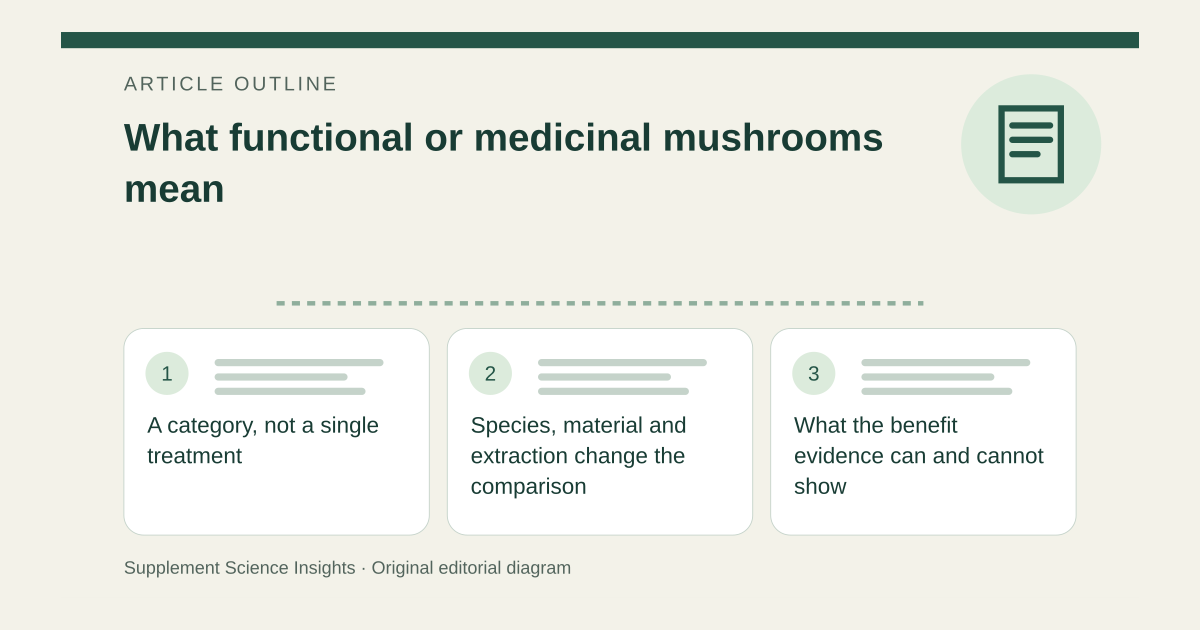
A category, not a single treatment
Functional mushroom is a commercial term used for mushrooms promoted for effects beyond ordinary nutrition. Medicinal mushroom refers to fungi or preparations studied or traditionally used for health purposes. Neither phrase identifies one species, one chemical composition or a single proven benefit. [1]
NCI's evidence summary discusses examples including turkey tail and reishi. These are different fungi with different preparations and research histories. A conclusion about a specified extract cannot be applied to the whole category merely because both labels contain the word mushroom. [1]
Species, material and extraction change the comparison
A product may use a fruiting body, fungal mycelium or an extract of selected material. Extraction changes which components are concentrated. Polysaccharides, including beta-glucans, and compounds such as triterpenoids are studied, but their presence varies with species and preparation. [1]
Total polysaccharide content is not necessarily the same as fungal beta-glucan content. NCI discusses the importance of distinguishing material from the growth substrate and the fungal components of interest. A numerical extract claim is useful only when its measurement and denominator are clear. [1]
What the benefit evidence can and cannot show
Laboratory studies can investigate mechanisms, such as interactions with immune cells. That does not demonstrate that a retail powder improves immunity in a clinically useful way. Human evidence must identify the preparation, condition and measured outcome. [1]
Some specialized mushroom-derived preparations have been used as adjuncts to cancer care in particular countries. Those records are not evidence that an ordinary mushroom supplement treats cancer or can replace treatment. NCI states that FDA has not approved medicinal mushrooms to treat cancer or other medical conditions. [1]
Safety depends on the preparation and the person
A long history of use does not establish the safety of every concentrated extract. Quality, ingredient identity and possible interactions remain relevant, especially when a person is receiving medical treatment. Discuss supplement use with the treating team rather than adding a product on the strength of an immune-support claim. [2][1]
No specific product is recommended here because the broad marketing category does not establish exact identity or equivalence to a studied preparation. NIH also cautions that quality seals do not guarantee clinical effectiveness. [2][1]
A hypothetical study-to-product check
Imagine a study names a defined turkey-tail extract while a retail blend lists several mushrooms without extract specifications. The blend is not demonstrated equivalent to the study material. Record the mismatch instead of treating the study as evidence for every ingredient in the blend. [1]
| Question | Why it matters |
|---|---|
| Which species? | Different fungi are not interchangeable |
| Which part or preparation? | Composition changes with material and extraction |
| Which outcome? | Mechanisms and clinical benefits are different |
Sources for this article
- National Cancer Institute — Medicinal Mushrooms PDQ
Source consulted: 2026-09-20. This is a reference resource, not a claim that we conducted the studies or tested a product. - Dietary Supplements: What You Need to Know - Consumer
Source consulted: 2026-09-20. This is a reference resource, not a claim that we conducted the studies or tested a product.