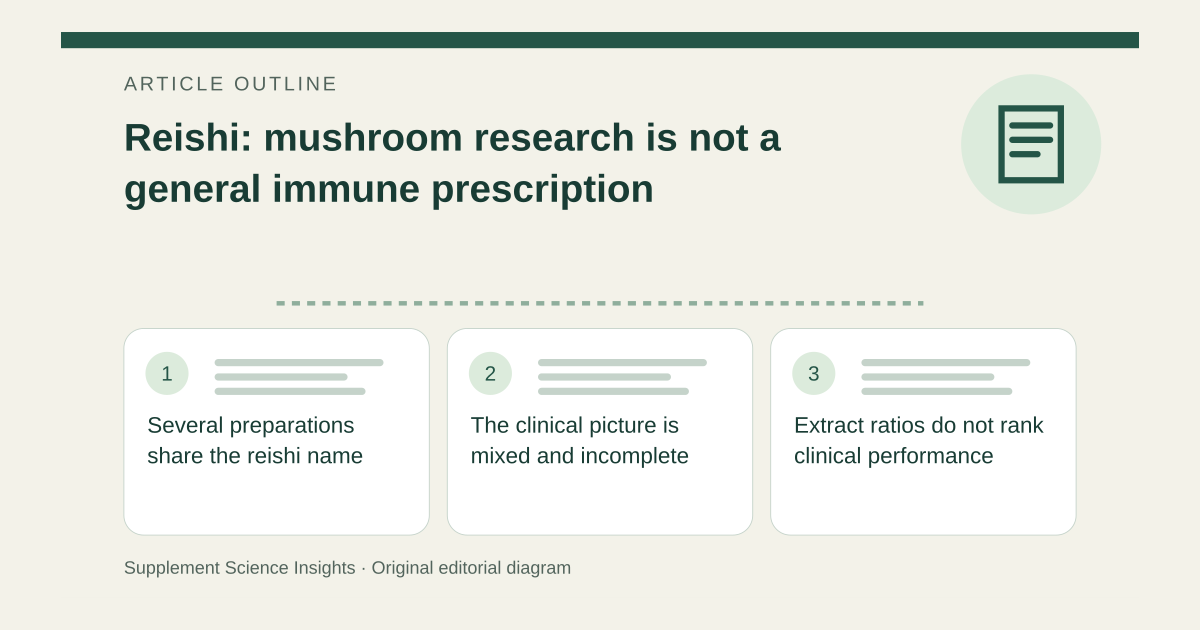
Several preparations share the reishi name
Reishi is a mushroom used in traditional Asian medical systems. Products include powders, extracts and spore preparations. Memorial Sloan Kettering's reference discusses compounds such as beta-glucans and triterpenes, but their presence does not make every preparation equivalent. [1]
A product should be identified by its species information, material used and preparation. The common name alone cannot establish that it matches a study or another item on a comparison page. [1]
The clinical picture is mixed and incomplete
MSK describes preliminary findings alongside negative trials for several proposed uses. It calls for further research on reishi as an adjunct to cancer care. Laboratory immune activity is not proof that a supplement prevents infection, treats cancer or benefits someone with an immune disorder. [1]
For a claim about a particular symptom, ask whether that symptom was measured in humans using the same preparation. A changed immune marker and a meaningful health outcome are different findings. A traditional use can explain the research question without answering it. [1]
Extract ratios do not rank clinical performance
A label may emphasize an extraction ratio or the mass of starting mushroom. Those figures describe aspects of preparation, but they do not establish the amount of every constituent or a superior clinical effect.
When two labels use different bases, do not simply choose the larger number. Record the actual extract mass separately from any source-equivalent mass and any quantified constituent. If the study preparation cannot be matched, keep that limitation explicit rather than filling it with an assumption.
Bleeding, liver and treatment considerations
MSK reports adverse effects including nausea, insomnia and liver-injury reports. It cautions about increased bleeding risk with blood thinners and possible concerns with immunosuppressants. Reishi spore products may also affect the tumor-marker measurement CA72-4. [1]
People receiving cancer treatment or taking anticoagulants should discuss reishi with their care team. A supplement promoted for immunity can be particularly unsuitable when treatment intentionally modifies immune activity. Do not interpret a changed laboratory result without disclosing supplement use. [1]
Keep extract and source-equivalent weights separate
Imagine a hypothetical capsule contains 300 milligrams of extract and states a ten-to-one starting-material ratio. The arithmetic corresponds to 3,000 milligrams of starting material, but the capsule still contains 300 milligrams of extract.
Neither number reveals a beta-glucan or triterpene amount unless it is separately measured and disclosed. Neither proves an equivalent dose to an unextracted powder. A clear comparison table should preserve those distinctions instead of converting every label into a single misleading potency score. The example does not establish a recommended serving. Different extraction methods also make a simple weight comparison an incomplete description.
| Hypothetical figure | What it means |
|---|---|
| 300 mg | Actual extract mass |
| 10:1 | Stated starting-material relationship |
| 3,000 mg equivalent | Not the capsule's extract mass |
Sources for this article
- Memorial Sloan Kettering — Reishi Mushroom
Source consulted: 2026-09-17. This is a reference resource, not a claim that we conducted the studies or tested a product.