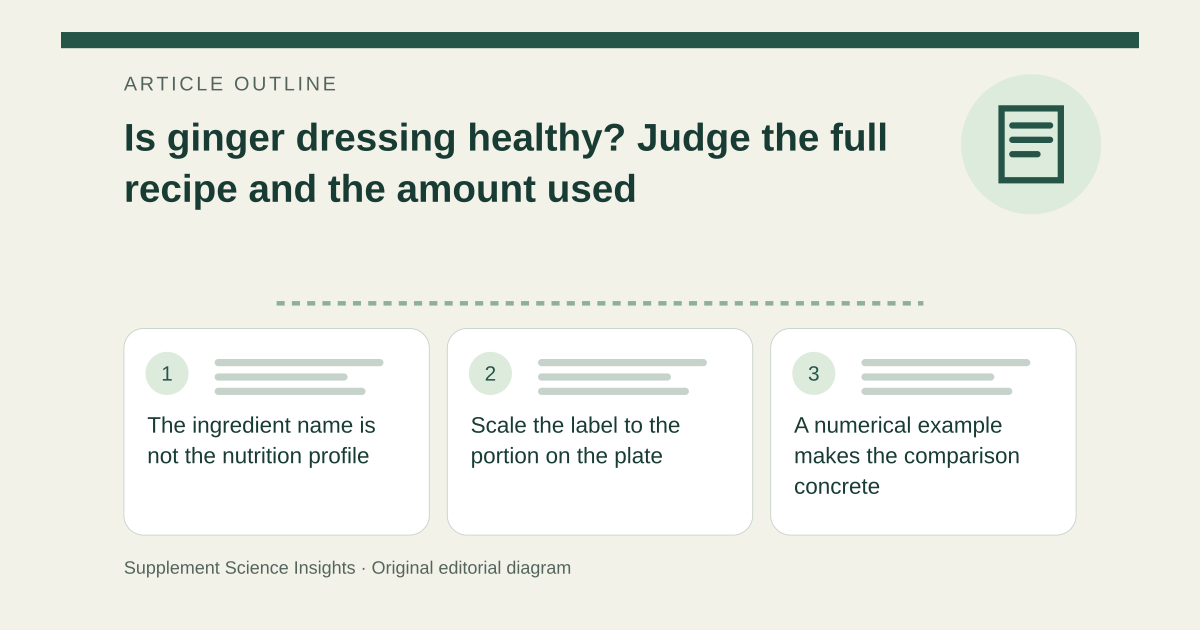
The ingredient name is not the nutrition profile
CSU includes dressings among ginger’s culinary uses. Two ginger dressings can still differ considerably in their oil, salt-containing ingredients and added sugars. Read the full Nutrition Facts panel and ingredient list, or account for the recipe ingredients when preparing it at home. [1][2]
Scale the label to the portion on the plate
FDA explains that nutrition information is normally stated per labeled serving. A free pour can be larger than that serving. Measuring once can show how the actual amount compares, without implying that everyone needs the same portion or that a dressing must be avoided. [2]
A numerical example makes the comparison concrete
Imagine a dressing lists 300 mg sodium per two tablespoons and the meal uses four tablespoons. That contributes 600 mg sodium. The arithmetic describes this hypothetical serving, not every ginger dressing. Compare alternatives at equal amounts and consider the rest of the meal rather than deciding from the front-label flavor name. [2]
| Situation | Practical interpretation |
|---|---|
| 2 tablespoons at 300 mg sodium | One hypothetical labeled serving |
| 4 tablespoons | 600 mg sodium in this example |
| Same ginger flavor | Can have a different overall recipe |
Sources for this article
- Ginger – Food Smart Colorado
Source consulted: 2026-09-20. This is a reference resource, not a claim that we conducted the studies or tested a product. - How to Understand and Use the Nutrition Facts Label | FDA
Source consulted: 2026-09-20. This is a reference resource, not a claim that we conducted the studies or tested a product.