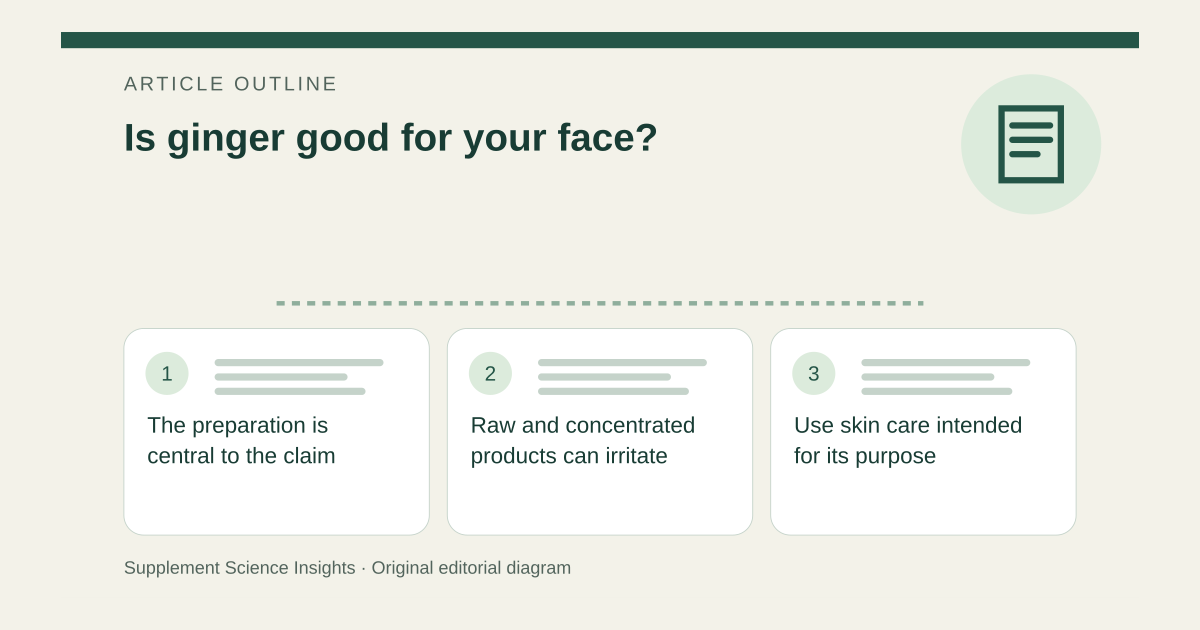
The preparation is central to the claim
A dermatology review discusses ginger-related research, but its abstract does not establish an effective home facial recipe. An isolated derivative in a tested cosmetic is different from rubbing raw rhizome or juice onto skin. Do not assume all products have the same evidence. [1]
Raw and concentrated products can irritate
MSK describes dermatitis associated with ginger, and Poison Control warns that essential oils can cause rashes. Burning is not a useful sign that acne, pigmentation or aging is being treated. Avoid applying oils to damaged skin and keep products away from eyes. [2][3]
Use skin care intended for its purpose
For a finished cosmetic, follow its directions and introduce it cautiously. AAD provides guidance on testing a new skin-care product and stopping it if a reaction occurs. Such a test does not establish effectiveness or guarantee absence of future allergy. [4]
Judge the actual skin outcome
Imagine a mask creates temporary warmth and redness. That is not evidence of collagen production or improved pigmentation. Stop an irritating product and obtain appropriate advice for persistent acne, rash or other skin concerns. [2][4]
| Claim | Missing evidence |
|---|---|
| Antioxidant in a model | Benefit on human face |
| Contains ginger | Equivalent to tested formula |
| Skin feels hot | Not proof of improvement |
| Natural mask | Not irritation-free |
Sources for this article
- Clinical dermatologic applications of ginger: a focused review.
Source consulted: 2026-09-21. This is a reference resource, not a claim that we conducted the studies or tested a product. - Ginger | Memorial Sloan Kettering Cancer Center
Source consulted: 2026-09-21. This is a reference resource, not a claim that we conducted the studies or tested a product. - Essential oils: Poisonous when misused | Poison Control
Source consulted: 2026-09-21. This is a reference resource, not a claim that we conducted the studies or tested a product. - How to test skin care products
Source consulted: 2026-09-21. This is a reference resource, not a claim that we conducted the studies or tested a product.