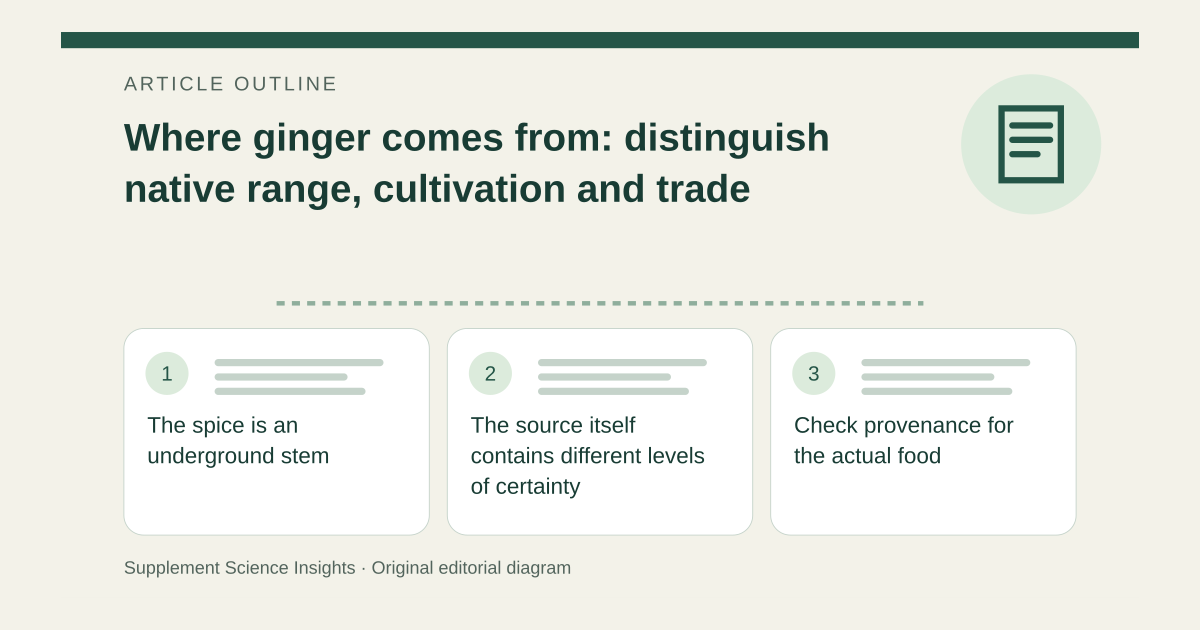
The spice is an underground stem
The familiar knobbly piece is a rhizome, a modified stem rather than a true root. Kew identifies Zingiber officinale as the source of culinary ginger. Other plants called ginger can belong to different species, so a common name alone does not identify the crop or its origin. [1]
The source itself contains different levels of certainty
Kew’s accepted-range entry gives the eastern Himalaya to south-central China, while its older narrative profile says the species is possibly native to India. These statements should not be flattened into a precise modern-country birthplace. Long cultivation and movement make the historical question different from documenting a current shipment. [1]
Check provenance for the actual food
Imagine a store sells ginger packaged in one country but grown in another. Packaging location, farm origin and the species’ native range describe different things. Use the supplier’s traceability information for that purchase rather than inferring its origin from the word tropical or a traditional recipe associated with it. [1][2]
| Choice | Practical interpretation |
|---|---|
| Native range | Botanical history |
| Country grown | Current agricultural provenance |
| Country packed | May be a different location |
Sources for this article
- Zingiber officinale Roscoe | Plants of the World Online | Kew Science
Source consulted: 2026-09-20. This is a reference resource, not a claim that we conducted the studies or tested a product. - Ginger - Vegetable Resources Vegetable Resources
Source consulted: 2026-09-20. This is a reference resource, not a claim that we conducted the studies or tested a product.