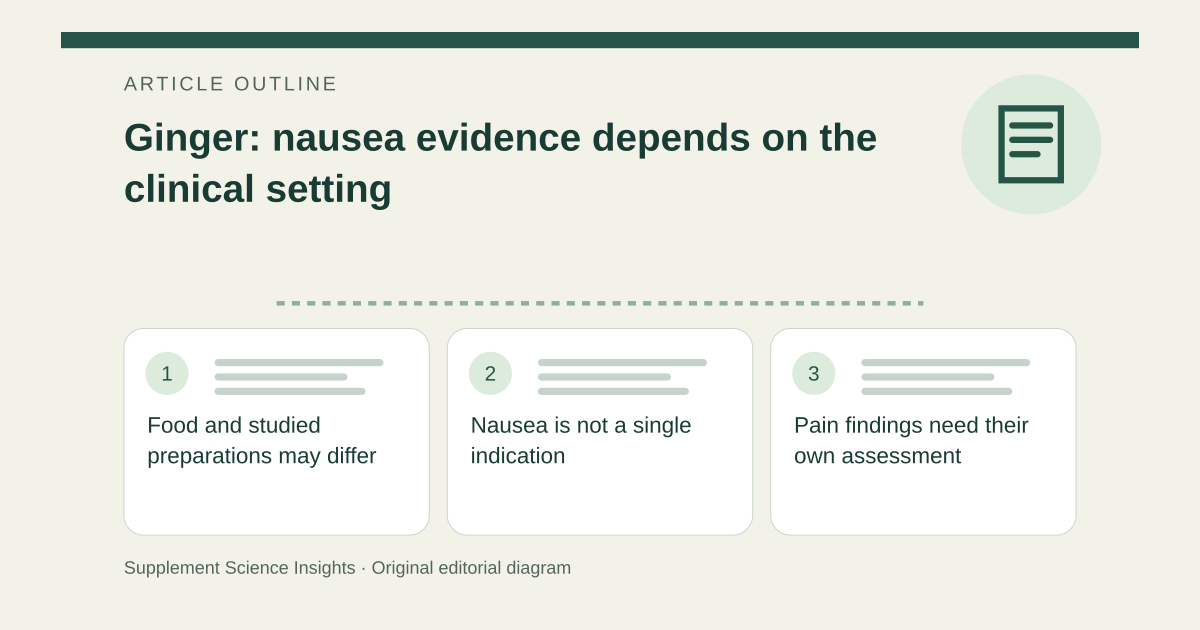
Food and studied preparations may differ
Ginger, Zingiber officinale, is used in foods, drinks and supplements. Much of the clinical research has tested supplements rather than ordinary foods. A ginger-flavored drink does not establish the amount or preparation used in a study. [1]
Record whether a paper tested powder, extract or another defined preparation. A topical product also represents a different route from swallowing a capsule. Keeping these distinctions visible prevents a general ingredient name from doing more work than the evidence supports. [1]
Nausea is not a single indication
NCCIH describes possible benefit for nausea and vomiting associated with pregnancy. Most studies of motion sickness have not shown benefit. It remains uncertain whether ginger adds useful benefit to standard treatment for chemotherapy-related nausea or nausea after surgery. [1]
These findings can coexist because the causes, populations and co-treatments differ. A favorable pregnancy-nausea result should not be presented as proof that ginger treats every cause of vomiting. Supplement use in pregnancy should still be discussed with the maternity-care team. [1]
Pain findings need their own assessment
Research suggests possible improvement in menstrual-cramp severity. Some knee-osteoarthritis research also suggests benefit, but much of it is poor quality. Topical ginger has not been shown helpful for knee-osteoarthritis symptoms. [1]
For any pain claim, distinguish symptom intensity, function and rescue-medication use. A small difference in a questionnaire does not necessarily mean people returned to usual activities or needed less treatment. The exact endpoint and quality of the comparison determine what can reasonably be concluded. [1]
Tolerability does not remove clinical context
Oral ginger can cause heartburn, abdominal discomfort, diarrhea and irritation of the mouth or throat. Medicines and the complete supplement formula should be reviewed with a clinician or pharmacist rather than assuming all preparations are interchangeable. [1]
Pregnancy supplement research does not make every product suitable, and breastfeeding safety information is limited. Persistent or substantial nausea needs assessment of its cause; a product trial should not delay appropriate care or replace an indicated anti-nausea treatment. [1]
Keep add-on treatment in the description
Imagine a hypothetical study gives both groups a standard anti-nausea medicine and adds ginger only to one group. Its question is whether ginger adds benefit to that medicine, not whether ginger can replace it.
If vomiting episodes improve but nausea intensity does not, a fair account reports both. The fictional example illustrates two distinct outcomes and does not provide a treatment regimen.
| Hypothetical trial detail | Meaning |
|---|---|
| Standard treatment in both groups | Ginger studied as an addition |
| Fewer vomiting episodes | One measured outcome |
| Nausea score unchanged | Do not claim improvement in every symptom |
Start with the cause and the measured outcome
The most useful ginger claim identifies the setting, preparation and comparison. Food enjoyment does not require a medical promise. This page summarizes research distinctions without recommending a product, pregnancy dose or replacement for prescribed nausea treatment.
Sources for this article
- NCCIH — Ginger: Usefulness and Safety
Source consulted: 2026-09-17. This is a reference resource, not a claim that we conducted the studies or tested a product.
Considering a supplement?
Ingredient evidence alone does not establish which retail product is suitable. No single featured product is recommended for this article.
Compare ginger formulations (retail checks pending) → No overall winner
Compare formulations → · How we select products