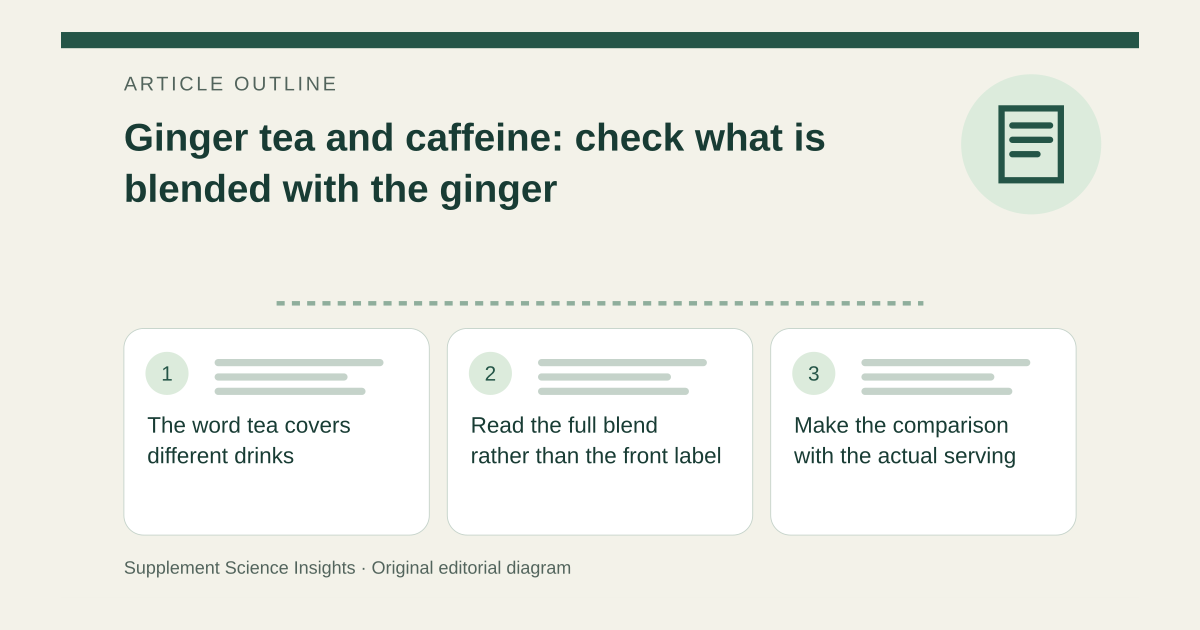
The word tea covers different drinks
Ginger can be steeped as a herbal infusion. That is different from adding ginger to leaves of the tea plant. Harvard’s caffeine guide distinguishes herbal infusions from caffeinated black and green teas; a prominent ginger name on the package does not identify everything in the blend. [1][2]
Read the full blend rather than the front label
Look for black tea, green tea or a stated caffeine content. Decaffeinated tea is also different from a naturally caffeine-free ginger infusion: small residual amounts can remain. Brewing strength and the amount consumed affect exposure, so a single caffeine number cannot describe all ginger drinks. [1]
Make the comparison with the actual serving
Imagine one mug contains sliced ginger and hot water while another is a ginger black-tea blend. Both taste of ginger, but only the second has tea leaves as a caffeine source. If avoiding caffeine is the goal, choose a clearly identified caffeine-free blend and check any added ingredients. [1]
| Situation | Practical interpretation |
|---|---|
| Ginger and water | No caffeinated tea leaves |
| Ginger black tea | Contains a caffeine source |
| Decaffeinated blend | Not necessarily zero caffeine |
Sources for this article
- Caffeine • The Nutrition Source
Source consulted: 2026-09-20. This is a reference resource, not a claim that we conducted the studies or tested a product. - Ginger – Food Smart Colorado
Source consulted: 2026-09-20. This is a reference resource, not a claim that we conducted the studies or tested a product.