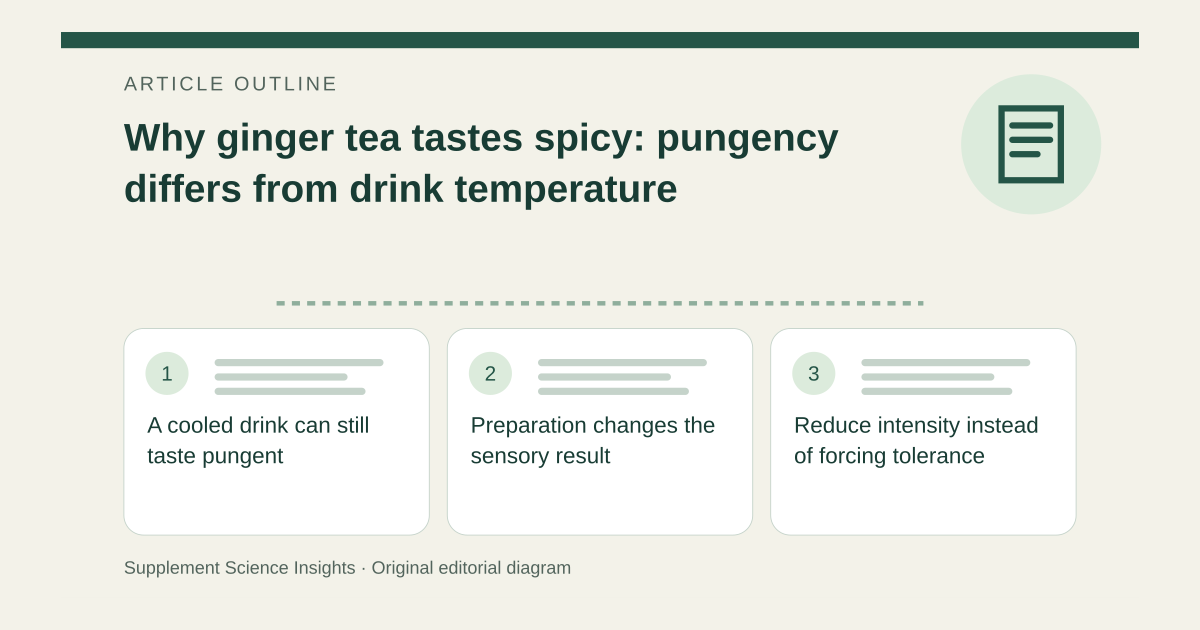
A cooled drink can still taste pungent
Kew identifies several phenolic compounds contributing to ginger’s pungency. They explain why the characteristic bite is not simply a hot-water effect. A cup can be physically cool and still feel sharp, while a weak infusion can be dangerously hot because of its temperature. [1]
Preparation changes the sensory result
The form and amount of ginger and the amount of water influence how concentrated a drink tastes. Fresh slices and powder also create different textures. Taste alone does not quantify gingerols or identify an equivalent dose to a preparation used in a clinical study. Stronger is a flavor description, not proof of a stronger health benefit. [1][2]
Reduce intensity instead of forcing tolerance
Imagine a cup is unpleasantly sharp. Diluting it or using less ginger next time are ordinary culinary adjustments. NCCIH notes that ginger can cause heartburn, abdominal discomfort and mouth or throat irritation. Persistent burning should not be accepted as evidence that the drink is working; stop the offending preparation and seek advice when symptoms persist. [2]
| Choice | Practical interpretation |
|---|---|
| Water temperature | Physical heat |
| Ginger pungency | Chemical sensation |
| Sharper flavor | Not proof of better treatment |
Sources for this article
- Zingiber officinale Roscoe | Plants of the World Online | Kew Science
Source consulted: 2026-09-20. This is a reference resource, not a claim that we conducted the studies or tested a product. - Ginger: Usefulness and Safety | NCCIH
Source consulted: 2026-09-20. This is a reference resource, not a claim that we conducted the studies or tested a product.