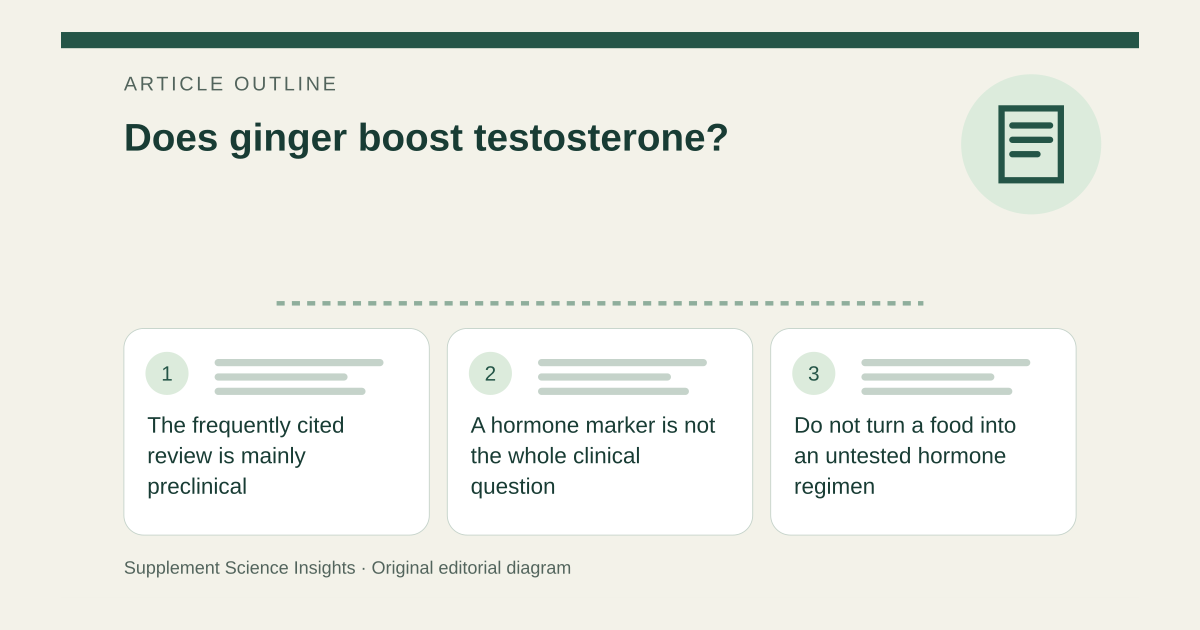
The frequently cited review is mainly preclinical
A review of ginger and testosterone discussed animal findings involving oxidative stress, luteinizing hormone and testicular function. Its conclusion explicitly said the effect had not been confirmed in humans. These mechanisms are research hypotheses, not proof that a ginger shot raises testosterone. [1]
A hormone marker is not the whole clinical question
A useful intervention would need reliable human evidence about the relevant population, symptoms, fertility outcomes and harms. Findings in injured or diabetic animals cannot simply be transferred to healthy adults seeking muscle gain or sexual performance. [1]
Do not turn a food into an untested hormone regimen
The inspected sources do not establish a ginger amount for testosterone treatment. Concentrated ginger can cause digestive irritation and has medication cautions. Taking larger amounts does not solve the lack of human efficacy evidence. [2][3]
Evaluate symptoms rather than marketing
Imagine fatigue is assumed to mean low testosterone and treated with ginger capsules. Fatigue alone cannot identify its cause. Seek appropriate assessment and interpret any hormone testing with a clinician rather than treating an online mechanism as a diagnosis. [4][1]
| Claim | Evidence gap |
|---|---|
| Animal testosterone rises | Human clinical effect |
| Antioxidant mechanism | Meaningful symptom benefit |
| More ginger | Validated treatment amount |
| Improved energy | Not a hormone diagnosis |
Sources for this article
- Ginger and Testosterone - PMC
Source consulted: 2026-09-21. This is a reference resource, not a claim that we conducted the studies or tested a product. - Ginger: Usefulness and Safety | NCCIH
Source consulted: 2026-09-21. This is a reference resource, not a claim that we conducted the studies or tested a product. - Ginger | Memorial Sloan Kettering Cancer Center
Source consulted: 2026-09-21. This is a reference resource, not a claim that we conducted the studies or tested a product. - Dietary Supplements: What You Need to Know
Source consulted: 2026-09-21. This is a reference resource, not a claim that we conducted the studies or tested a product.