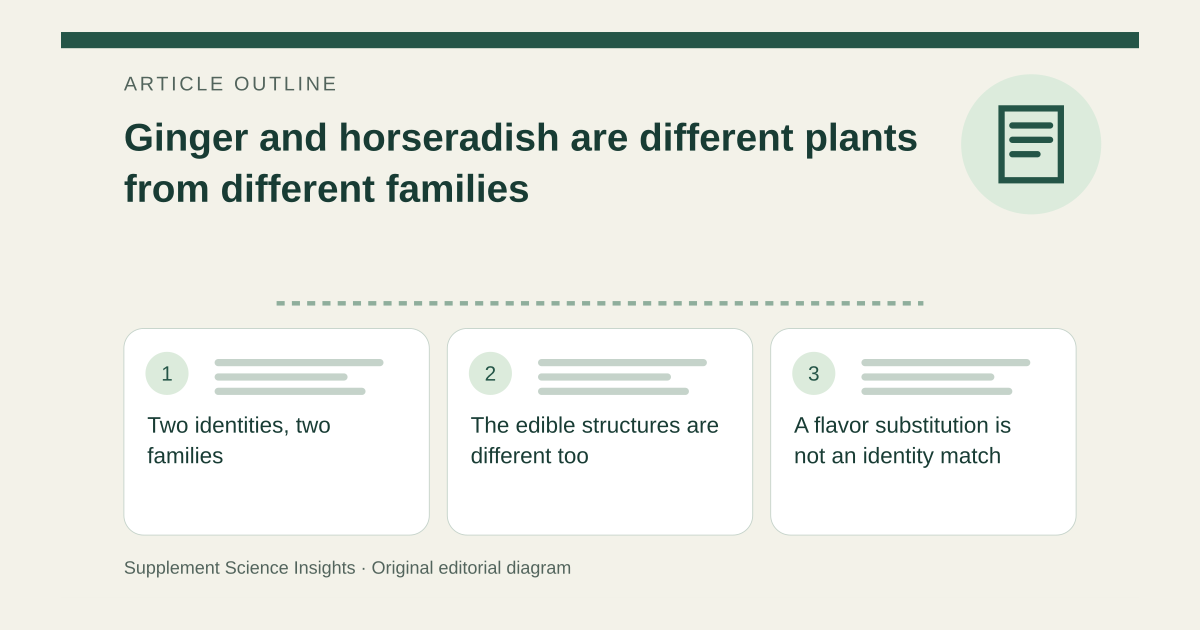
Two identities, two families
Culinary ginger is Zingiber officinale in the ginger family. Horseradish is Armoracia rusticana in Brassicaceae, the mustard family. Similar kitchen uses do not place them in the same genus or family. [1][2]
The edible structures are different too
Ginger is commonly called a root, but the familiar branched piece is a rhizome: an underground stem. Horseradish is grown mainly for its pungent fleshy root. This distinction is useful for identification, even though recipes often group both among strongly flavored underground vegetables. [3][2]
A flavor substitution is not an identity match
Imagine a sauce needs ginger but only prepared horseradish is available. The substitution changes the flavor and possibly the added vinegar, salt or other ingredients. Use a recipe suited to the substitute rather than expecting the same result merely because both are pungent. [2][4]
| Situation | Practical interpretation |
|---|---|
| Ginger | Zingiberaceae; rhizome |
| Horseradish | Brassicaceae; root |
| Both pungent | Not evidence of close relatedness |
Sources for this article
- Zingiber officinale Roscoe | Plants of the World Online | Kew Science
Source consulted: 2026-09-20. This is a reference resource, not a claim that we conducted the studies or tested a product. - Horseradish: Americas Favorite Root? // Missouri Environment and Garden News Article // Integrated Pest Management, University of Missouri
Source consulted: 2026-09-20. This is a reference resource, not a claim that we conducted the studies or tested a product. - Growing Ginger at Home | Virginia Cooperative Extension | Virginia Tech
Source consulted: 2026-09-20. This is a reference resource, not a claim that we conducted the studies or tested a product. - Ginger – Food Smart Colorado
Source consulted: 2026-09-20. This is a reference resource, not a claim that we conducted the studies or tested a product.