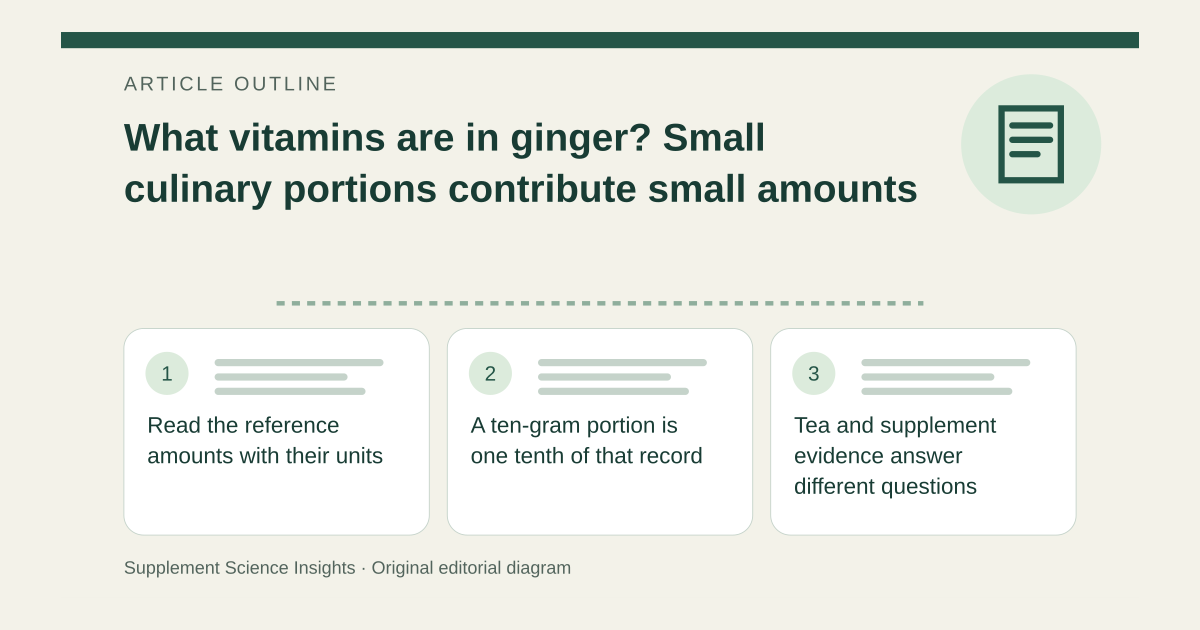
Read the reference amounts with their units
USDA’s historical SR Legacy record lists, per 100 g raw ginger, 5 mg vitamin C, 0.16 mg B6, 0.75 mg niacin and 11 micrograms total folate. It also lists small amounts of thiamin, riboflavin and vitamin E. These are food-composition estimates, not a current batch assay. [1]
A ten-gram portion is one tenth of that record
For a hypothetical 10 g portion, those figures become 0.5 mg vitamin C, 0.016 mg B6, 0.075 mg niacin and 1.1 micrograms folate. The arithmetic illustrates why the presence of a vitamin does not necessarily make ginger a substantial source in ordinary use. [1]
Tea and supplement evidence answer different questions
An infusion does not automatically contain every nutrient in the root placed into it. NCCIH also notes that much ginger research uses supplements rather than food. Neither a vitamin list nor a cup of ginger tea can be assumed to reproduce a studied supplement preparation. [2][1]
Use ginger for its place in the meal
Imagine a recipe uses 10 g fresh ginger across two equal portions. Each portion contains the contribution from roughly 5 g, not 100 g. Other foods in the meal will usually be the more important sources when planning vitamin adequacy. [1]
| Example | Interpretation |
|---|---|
| 100 g raw-ginger reference | 5 mg vitamin C |
| 10 g hypothetical portion | 0.5 mg vitamin C |
| 10 g shared between two portions | 0.25 mg vitamin C per portion before cooking effects |
Sources for this article
- USDA SR Legacy: raw ginger and whole egg nutrient records
Source consulted: 2026-09-20. This is a reference resource, not a claim that we conducted the studies or tested a product. - Ginger: Usefulness and Safety | NCCIH
Source consulted: 2026-09-20. This is a reference resource, not a claim that we conducted the studies or tested a product.