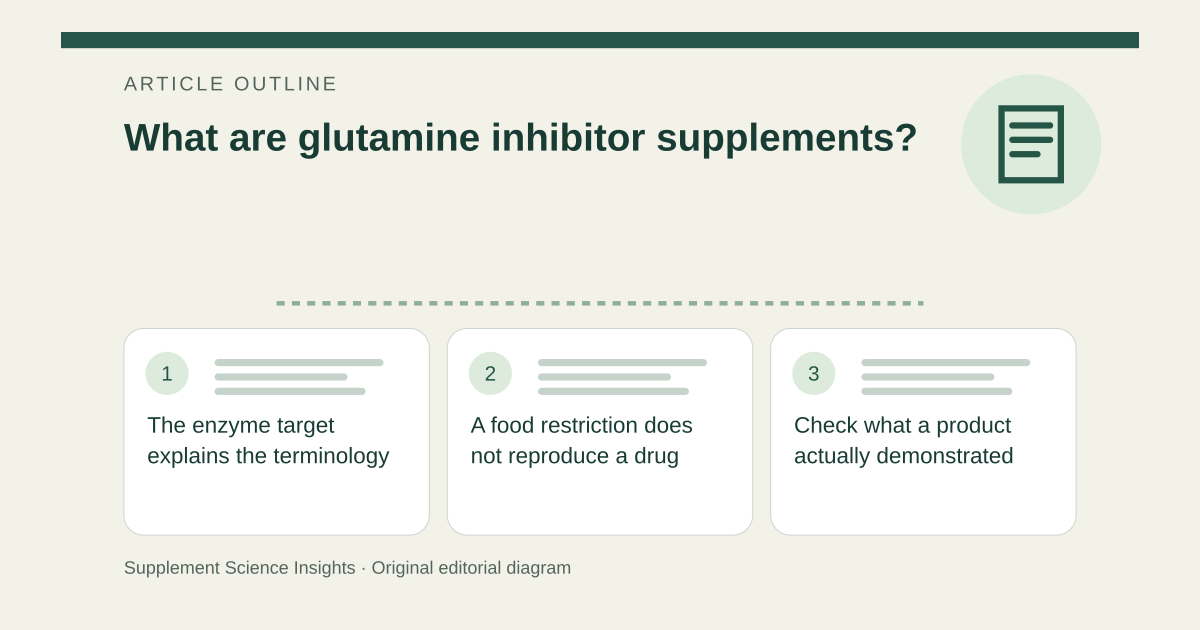
The enzyme target explains the terminology
NCI describes telaglenastat, also called CB-839, as an inhibitor of glutaminase, the enzyme that converts glutamine into glutamate. Its dictionary describes potential anticancer activity. This is a drug-development mechanism, not a recommendation for a dietary supplement or evidence that all cancers respond. [1]
A food restriction does not reproduce a drug
NCI identifies glutamine metabolism as one of several cancer research targets, alongside glucose and fatty-acid pathways. Cancer metabolism is adaptable. Cutting out a food or taking an herb cannot be assumed to produce the same target engagement as an investigated drug. [2]
Check what a product actually demonstrated
Imagine a supplement advertises glutamine blocking using a laboratory citation. A useful assessment needs the tested formulation, human population, clinical outcome and adverse effects. A pathway diagram alone supplies none of those answers. Discuss cancer nutrition and investigational treatment with the oncology team instead of using a product to replace care. [3][2]
| Claim | What it establishes |
|---|---|
| Mechanism or product name | A question to investigate |
| Matching human outcome | Evidence needed for a benefit claim |
| Individual suitability | Requires the actual formulation and context |
Sources for this article
- Telaglenastat — NCI Drug Dictionary
Source consulted: 2026-09-21. This is a reference resource, not a claim that we conducted the studies or tested a product. - DCB - Cancer Cell Biology Research - NCI
Source consulted: 2026-09-21. This is a reference resource, not a claim that we conducted the studies or tested a product. - Questions and Answers on Dietary Supplements | FDA
Source consulted: 2026-09-21. This is a reference resource, not a claim that we conducted the studies or tested a product.