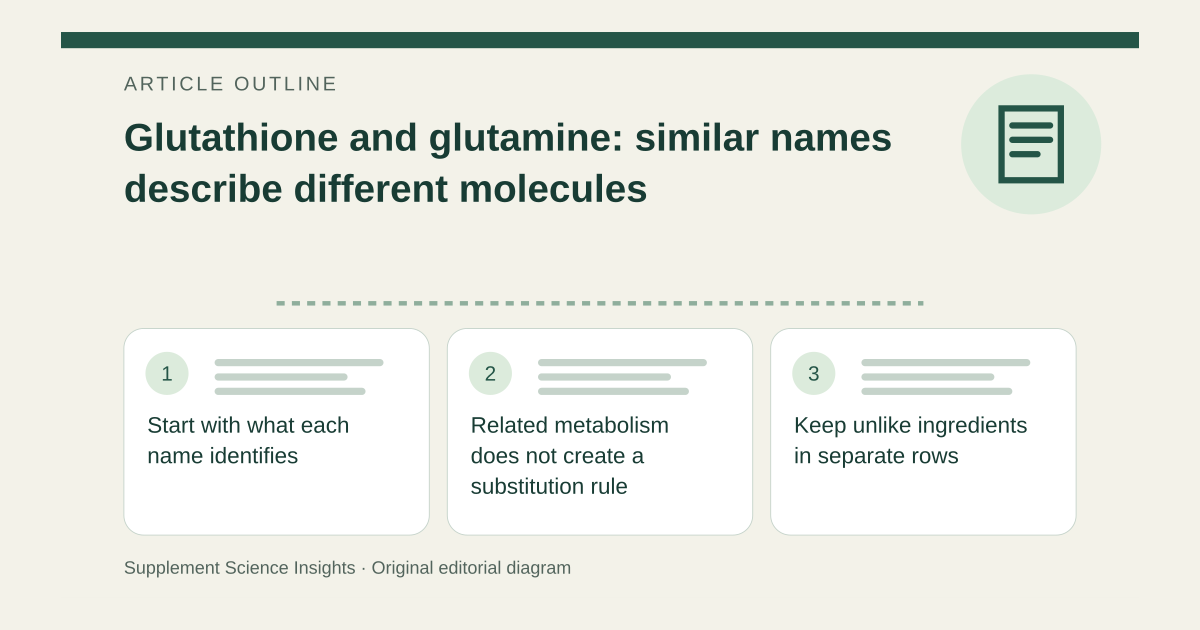
Start with what each name identifies
MedlinePlus lists glutamine among amino acids the body can make, with conditional essentiality in some settings. The GSS gene overview describes glutathione as a small molecule made from three amino-acid building blocks and involved in protection from damaging reactive molecules. [1][2]
One is therefore not simply an alternative spelling, brand name or reduced form of the other. A label that lists glutamine should not be recorded as supplying the same amount of glutathione. Molecular identity must be preserved before considering a biological claim. [1][2]
Related metabolism does not create a substitution rule
The body’s metabolic pathways connect many molecules, but a connection does not establish a direct conversion of swallowed doses or the same clinical effect. An antioxidant function in cells is also different from evidence that taking a particular product improves health. [1][2]
The cited sources explain normal roles and molecular categories; they do not establish a universal supplement amount or a comparison of retail formulations. For a clinical claim, look for the actual molecule, preparation, population and outcome studied. [1][2]
Keep unlike ingredients in separate rows
Imagine one label declares 500 mg glutamine and another 500 mg glutathione. The masses match, but the molecules differ. Calling the products equivalent because of the shared number would erase the most important identity distinction.
| Description | Interpretation |
|---|---|
| Glutamine | Individual amino acid |
| Glutathione | Three-amino-acid molecule |
| Equal labeled mass | Not proof of equivalent effect |
Sources for this article
- MedlinePlus: Amino acids
Source consulted: 2026-09-17. This is a reference resource, not a claim that we conducted the studies or tested a product. - MedlinePlus Genetics: GSS
Source consulted: 2026-09-17. This is a reference resource, not a claim that we conducted the studies or tested a product.