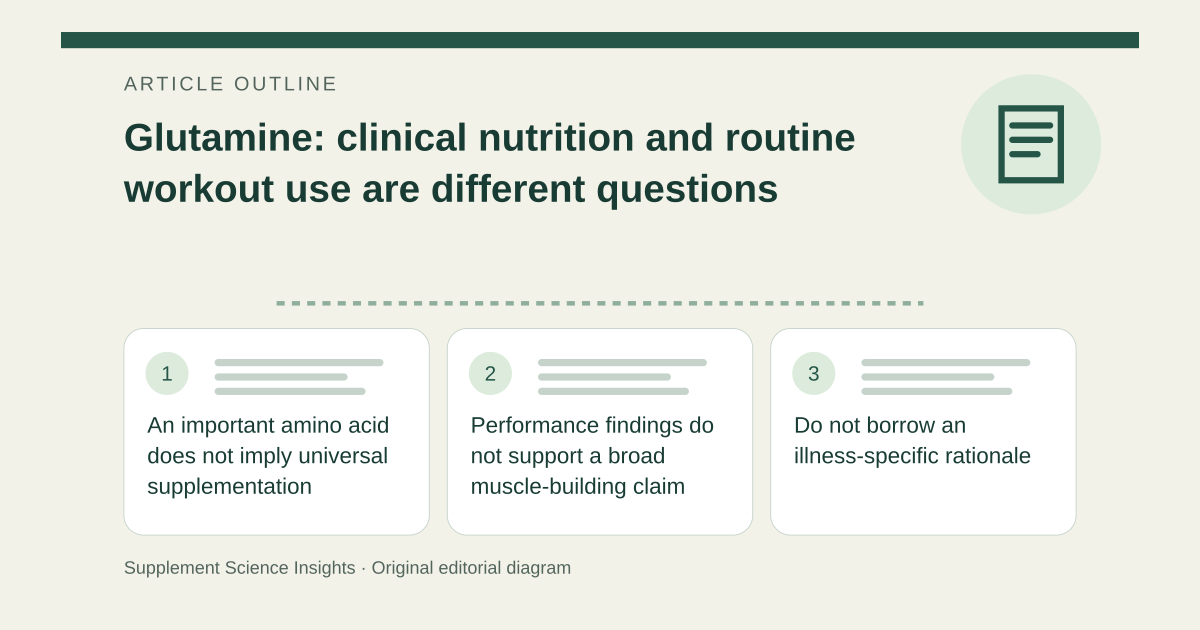
An important amino acid does not imply universal supplementation
Glutamine is abundant in the body and participates in metabolism and nitrogen transfer. It is made internally and obtained through protein-containing foods. Its biological importance explains why it is studied in both clinical nutrition and exercise. [1]
Those settings should remain distinct. Severe illness can alter nutritional requirements, but medical nutrition is not a model to copy into a routine fitness regimen. A need in one clinical context does not establish a deficiency or performance benefit in a healthy exerciser. [1]
Performance findings do not support a broad muscle-building claim
NIH ODS describes little support for taking glutamine alone to improve athletic performance. Some studies have examined soreness or recovery with mixed findings, while a strength-training study found no improvement in strength or lean tissue outcomes. [1]
Claims about preventing exercise-related respiratory illness also have limited support. A normal role in immune metabolism does not establish fewer infections from extra intake. Each proposed benefit needs an appropriate human endpoint and a comparison that isolates the ingredient. [1]
Do not borrow an illness-specific rationale
A hospitalized population, a person receiving specialized nutrition and a recreational athlete may differ in metabolism, illness severity, diet and treatment. Their evidence cannot be combined solely because the same amino acid is involved.
Likewise, a gut-related mechanism does not establish treatment for an unspecified digestive problem. A useful claim needs a diagnosed setting, defined preparation and measured outcome. This overview does not give a regimen for critical illness or assume that more of a normally present amino acid is always useful.
Supervised use and retail use have different contexts
Exercise studies summarized by ODS did not identify major adverse effects in their tested settings. That observation does not establish universal safety for high exposure, long duration or people with serious illness. Clinical use occurs within a broader care plan. [1]
When a powder contains several amino acids, its total blend amount does not establish the glutamine amount. Review the complete product and treatment context with a qualified professional rather than extrapolating from a study population that differs materially from the reader. [1]
Distinguish the blend from the ingredient
Imagine a fictional recovery powder lists 10 g of an amino-acid blend that includes glutamine but does not disclose individual quantities. It cannot be compared with a study of 10 g glutamine alone.
The total blend amount places an upper bound on any one component but does not reveal its actual share. Dividing evenly among the ingredients would invent information not supplied by the label.
| Fictional label | Valid conclusion |
|---|---|
| 10 g total amino-acid blend | Total mixture amount |
| Glutamine quantity absent | Actual amount unknown |
| Equal division among ingredients | Unsupported estimate |
Match the reason for use to the population studied
This reference does not recommend glutamine for muscle growth, immunity or digestive symptoms. Its metabolic role is important, but the supplement benefit remains a separate question. Clinical nutrition findings should retain their illness and treatment context rather than becoming a general fitness promise.
Sources for this article
- NIH ODS — Exercise and athletic performance: professional fact sheet
Source consulted: 2026-09-17. This is a reference resource, not a claim that we conducted the studies or tested a product.