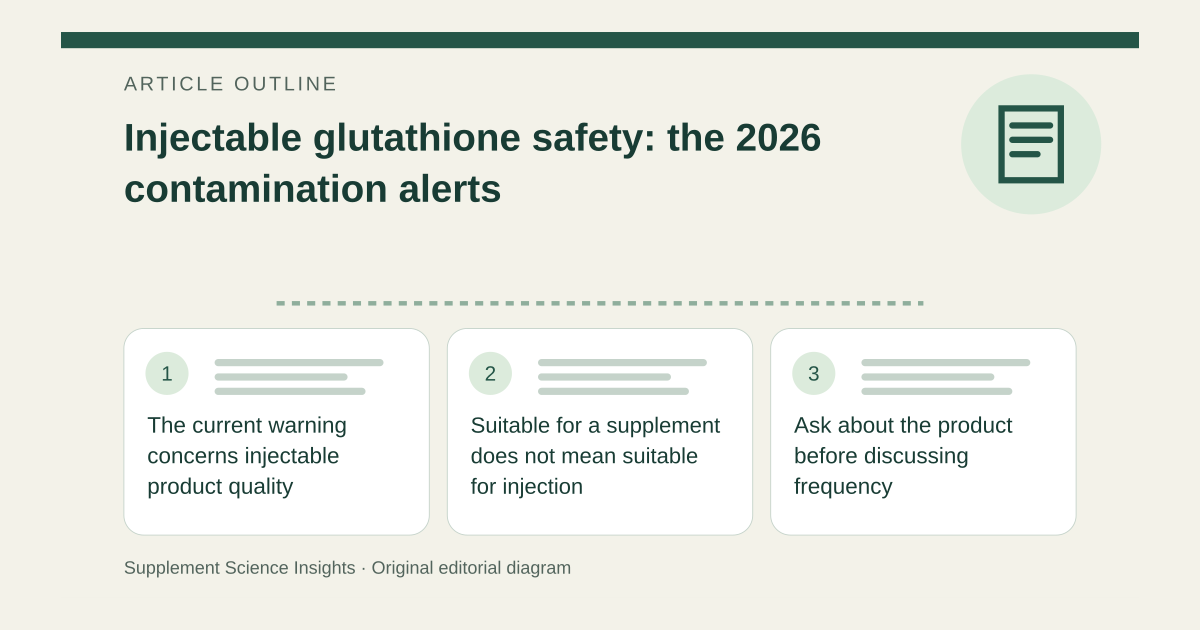
The current warning concerns injectable product quality
In its August 27, 2026 alert, FDA described adverse reactions after intravenous glutathione and warned against making injectable drugs from dietary-supplement-grade glutathione. CDC’s September 2026 investigation also includes administration under the skin or into muscle. [1][2]
Reported problems include fever, chills, nausea, dizziness and severe reactions requiring hospitalization. The agencies describe concerns about endotoxin contamination. Investigation details can change; the linked agency pages and recall notices should be checked for updates. [1][2]
Suitable for a supplement does not mean suitable for injection
FDA explains that ingredients intended for dietary supplements can contain contaminants inappropriate for an injectable drug. It also says final testing alone is insufficient: quality must be controlled throughout sourcing and preparation. [1][2]
CDC states that there is no FDA-approved glutathione drug product in the United States. A compounded preparation is not made FDA-approved by calling it pharmaceutical, wellness or antioxidant therapy. A clinic setting also does not remove the need to verify the actual product. [1][2]
Ask about the product before discussing frequency
CDC advises asking who compounded the product, whether ingredients were intended for injection, what sterility and endotoxin controls were used, and whether current recalls apply. Ask about alternatives that do not involve an injection. [1][2]
This guidance does not establish a safe universal injection amount, site, frequency or home reconstitution method. Changing those details cannot make unsuitable ingredients appropriate for injection. [1][2]
Know when to obtain care
After a recent injection, contact a healthcare professional promptly for symptoms such as fever, chills, severe body aches, vomiting, dizziness or injection-site pain, redness or swelling. CDC advises emergency care for severe symptoms such as difficulty breathing, fainting or signs of shock. Suspected adverse events can also be reported to FDA MedWatch. [1][2]
A smaller dose does not establish acceptable quality
Imagine a preparation uses an ingredient whose suitability for injection cannot be verified. Offering half as much does not establish sterility or acceptable endotoxin levels. Product suitability is a separate question from dose.
| Observation | What it means |
|---|---|
| Dietary-supplement grade | Not suitable evidence for injection |
| Compounded product | Not an FDA-approved glutathione drug |
| Severe symptoms after injection | Emergency assessment |
Sources for this article
- FDA: Do not use dietary supplement grade glutathione for injectables
Source consulted: 2026-09-17. This is a reference resource, not a claim that we conducted the studies or tested a product. - CDC: Adverse events linked to injectable glutathione — current situation
Source consulted: 2026-09-17. This is a reference resource, not a claim that we conducted the studies or tested a product.