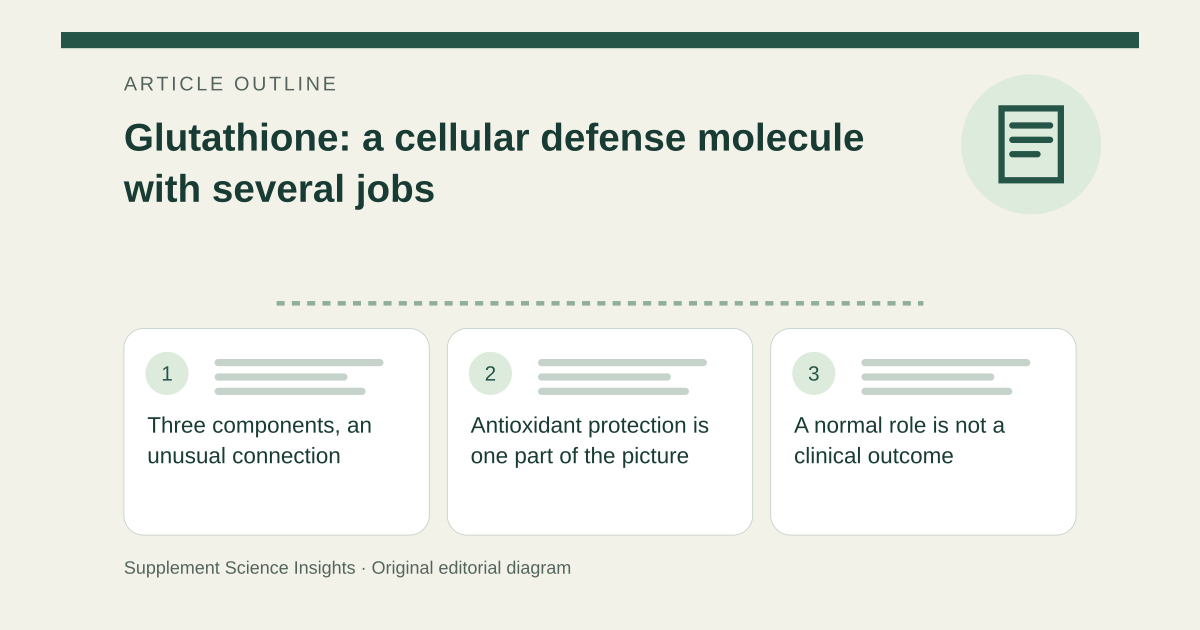
Three components, an unusual connection
Glutathione contains three amino-acid components rather than a long protein chain. Its glutamate–cysteine connection uses a different carboxyl group from the usual protein-backbone linkage. The cysteine component supplies a sulfur-containing group important to its chemistry. [1][2]
Cells make glutathione and maintain pools in different locations, including the cytosol and mitochondria. Its presence throughout tissues does not mean that one blood measurement describes every tissue equally. [1][2]
Antioxidant protection is one part of the picture
Enzyme systems use glutathione in reactions that handle peroxides. Glutathione also participates in conjugation reactions involved in processing some foreign chemicals and their metabolites. These are specific biochemical processes, not evidence for an undefined commercial detox program. [1][2]
It also participates in redox signaling: reversible chemical changes can alter protein behavior. Consequently, its biology involves regulation as well as protection. Describing it only as something that removes all oxidation misses the signaling side of the system. [1][2]
A normal role is not a clinical outcome
A cell needs glutathione, but this fact alone does not tell us whether an oral preparation reaches a particular tissue or improves a health outcome. Those questions require studies of the actual preparation, population and endpoint. The foundational review cited here explains biology; it is not a current treatment guideline or a comparison of retail products. [1][2]
Keep the endpoint attached to the claim
Imagine a study reports a higher blood glutathione concentration after an intervention. That establishes a change in the measured sample under those conditions. It does not by itself establish fewer illnesses, improved liver function or better exercise performance.
| Observation | What it means |
|---|---|
| Three amino-acid components | A small peptide |
| Cellular function | Explains biological importance |
| Higher measured concentration | Not automatically better health |
Sources for this article
- Lu: Glutathione synthesis — foundational mechanistic review
Source consulted: 2026-09-17. This is a reference resource, not a claim that we conducted the studies or tested a product. - MedlinePlus Genetics: GSS
Source consulted: 2026-09-17. This is a reference resource, not a claim that we conducted the studies or tested a product.