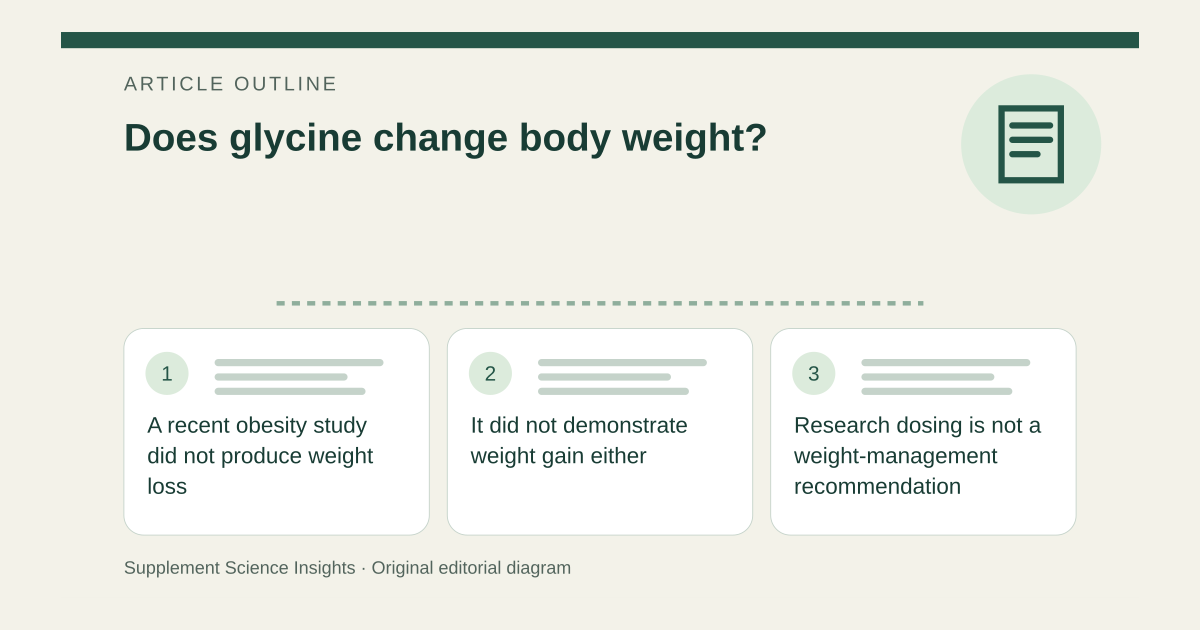
A recent obesity study did not produce weight loss
In a 2025 exploratory study, 19 adults with severe obesity took oral glycine at 100 milligrams per kilogram daily for two weeks. Body weight and body composition did not change significantly. Some laboratory markers changed, but this uncontrolled study was designed mainly to examine metabolism. [1]
It did not demonstrate weight gain either
The same short study found no significant weight increase. That is useful context but cannot prove that every dose and duration is weight-neutral. Findings about improved fat-free mass in malnourished dialysis patients, discussed in a broader review, concern a very different population and do not show fat gain in healthy users. [1][2]
Research dosing is not a weight-management recommendation
The obesity study had no placebo group and lasted only 14 days. Its laboratory findings do not establish a dose for losing fat, treating liver disease or improving long-term outcomes. The authors called for larger controlled studies; they reported public research funding and no competing interests. [1]
Investigate a change rather than assigning it to one ingredient
Imagine body weight rises after starting a glycine-containing shake. Review the entire formula, food intake, measurement conditions and other changes. A temporal association does not establish that glycine itself caused the gain; persistent unexplained changes merit clinical assessment. [3][2]
| Finding | Meaning |
|---|---|
| No change over two weeks | Limited short-term observation |
| Metabolic marker improves | Not necessarily fat loss |
| Lean mass in dialysis patients | Not general-population fat gain |
| Study dose | Not a proven slimming dose |
Sources for this article
- Metabolic impact of dietary glycine supplementation in individuals with severe obesity - PMC
Source consulted: 2026-09-21. This is a reference resource, not a claim that we conducted the studies or tested a product. - The effect of glycine administration on the characteristics of physiological systems in human adults: A systematic review - PMC
Source consulted: 2026-09-21. This is a reference resource, not a claim that we conducted the studies or tested a product. - Dietary Supplements: What You Need to Know
Source consulted: 2026-09-21. This is a reference resource, not a claim that we conducted the studies or tested a product.