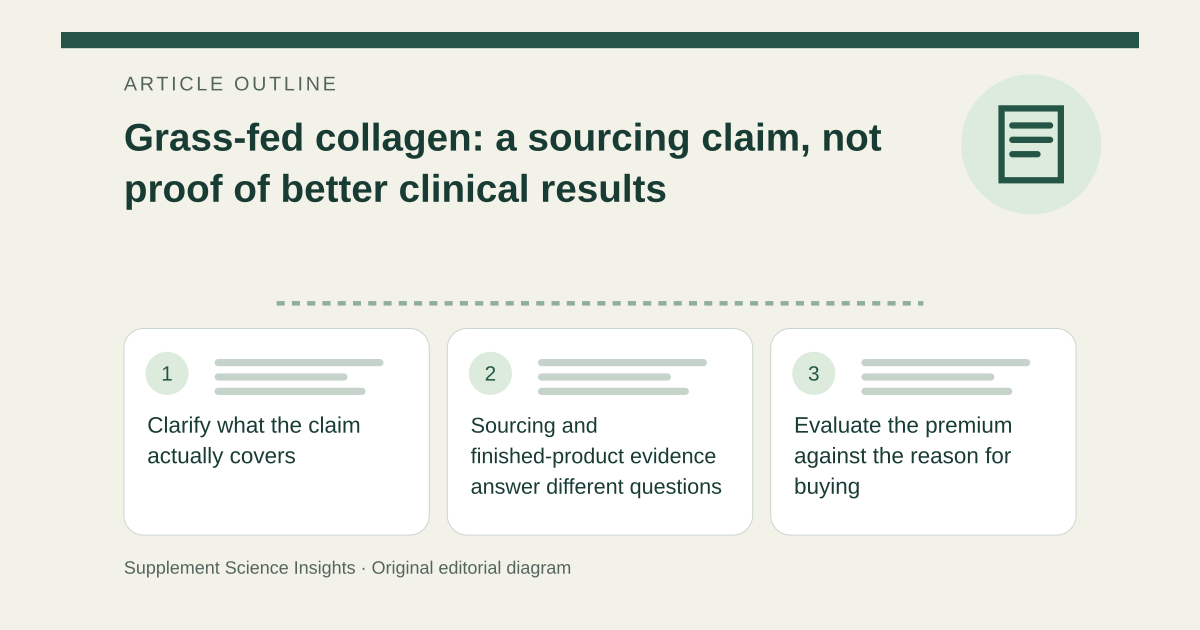
Clarify what the claim actually covers
Grass-fed wording concerns how the source animals were raised or fed. Ask which standard is used, what part of the supply chain it covers and who verifies it. USDA FSIS guidance discusses documentation and third-party verification of animal-raising claims for meat and poultry; that guidance should not be presented as automatic certification of every collagen supplement. [1]
Sourcing and finished-product evidence answer different questions
A feeding claim does not by itself establish the peptide profile, contaminant testing or clinical effect of the finished powder. Those require their own records or evidence. A well-documented sourcing preference can be meaningful without proving that a product improves skin or joints more than another one. [1][2]
Evaluate the premium against the reason for buying
Imagine two products provide similar labeled collagen amounts, but one costs more for a grass-fed claim. If documented animal sourcing is the priority, examine the standard and traceability. If the priority is a health outcome, look for relevant product evidence instead of assuming the farming term demonstrates superior effectiveness. [1][2]
| Observation | Interpretation |
|---|---|
| Animal-feeding claim | Check its standard and documentation |
| Product-quality test | A separate question |
| Higher price | Not proof of a larger health effect |
Sources for this article
- Availability of FSIS Guideline on Substantiating Animal-Raising or Environment-Related Labeling Claims | Food Safety and Inspection Service
Source consulted: 2026-09-20. This is a reference resource, not a claim that we conducted the studies or tested a product. - Dietary Supplements: What You Need to Know
Source consulted: 2026-09-20. This is a reference resource, not a claim that we conducted the studies or tested a product.