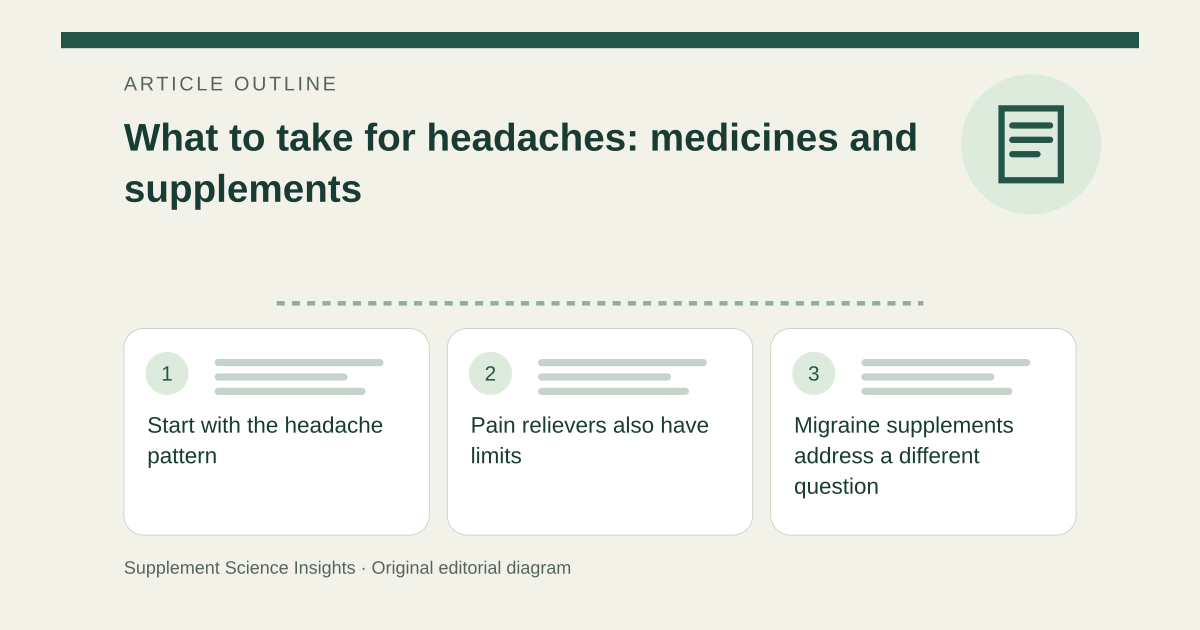
Start with the headache pattern
NHS advice includes drinking water, eating regular meals, resting and reducing stress. Paracetamol or ibuprofen may help when suitable. Keep a diary for recurring headaches, including timing, associated symptoms and medicine use, rather than assuming a vitamin deficiency. [1]
Pain relievers also have limits
Frequent painkiller use can itself contribute to headaches. NSAIDs can cause stomach bleeding, kidney problems and medicine interactions, and are not suitable for everyone. Follow the label and seek a longer-term plan when headaches or medicine use become frequent. [1][2]
Migraine supplements address a different question
NCCIH describes limited evidence for magnesium, riboflavin, coenzyme Q10 and feverfew in reducing migraine frequency. That is prevention evidence, not proof of immediate relief. Butterbur has serious liver-safety concerns and should not be treated as a routine natural option. [3]
Do not treat emergency symptoms as a supplement problem
Imagine a headache suddenly becomes extremely severe or occurs with new weakness, speech trouble, fever and a stiff neck. Seek emergency assessment. A recurring familiar headache still deserves review if its pattern changes or usual treatment no longer helps. [1]
| Situation | Practical response |
|---|---|
| Occasional uncomplicated headache | Suitable self-care and pain relief |
| Frequent painkiller use | Review possible overuse |
| Migraine prevention supplement | Limited, preventive evidence |
| Sudden extreme pain or neurological change | Emergency assessment |
Sources for this article
- Headaches - NHS
Source consulted: 2026-09-21. This is a reference resource, not a claim that we conducted the studies or tested a product. - NSAIDs - NHS
Source consulted: 2026-09-21. This is a reference resource, not a claim that we conducted the studies or tested a product. - Headaches: What You Need To Know | NCCIH
Source consulted: 2026-09-21. This is a reference resource, not a claim that we conducted the studies or tested a product.