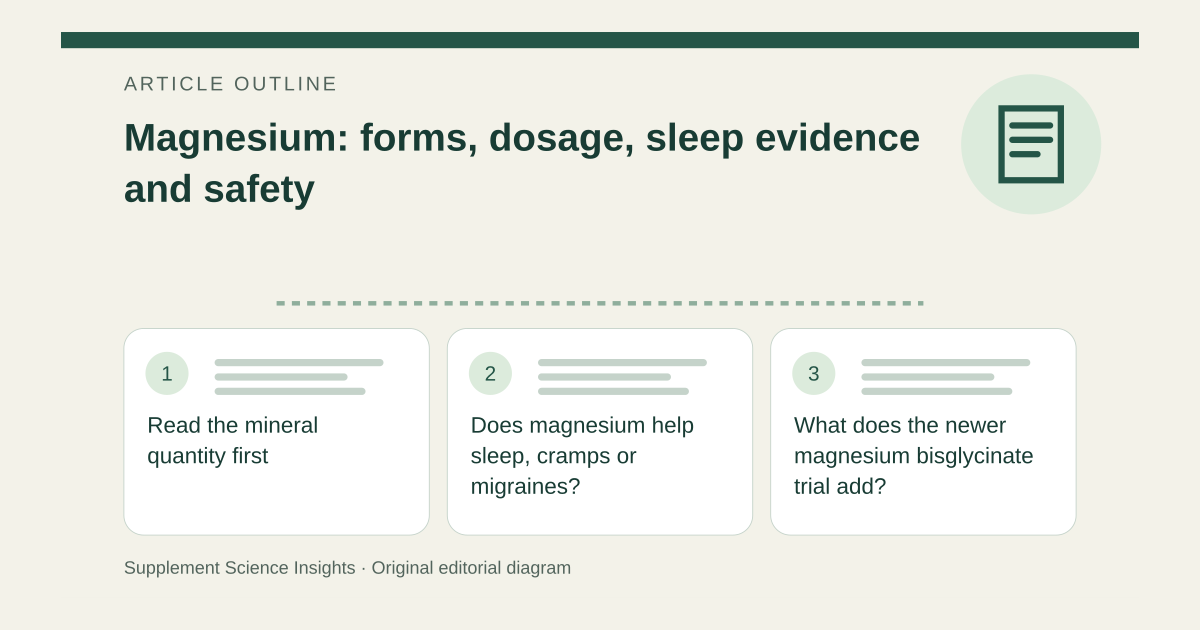
Read the mineral quantity first
A magnesium supplement has both a mineral amount and a chemical form. NIH ODS explains that the Supplement Facts panel declares elemental magnesium, rather than the weight of the whole magnesium-containing compound. The form may appear beside the mineral name. [1]
For a comparison, copy the elemental quantity, unit, form and serving size onto one line. Comparing a large compound-weight claim on one package with an elemental amount on another produces an unreliable ranking. [1]
Does magnesium help sleep, cramps or migraines?
Magnesium is an essential nutrient, but that does not make every symptom a magnesium deficiency. NCCIH describes the sleep research as limited and inconsistent. Small trials in selected populations do not establish that glycinate, citrate or L-threonate is universally best for sleep or that benefits should appear after a fixed number of nights. [2][3]
The Cochrane review of muscle-cramp trials found magnesium unlikely to provide a clinically meaningful preventive benefit for older adults with ordinary skeletal muscle cramps. Pregnancy-related cramps had uncertain evidence, and exercise-associated cramps lacked eligible randomized evidence in that review. These are distinct questions, not one positive or negative verdict on magnesium. [2][3]
What does the newer magnesium bisglycinate trial add?
A four-week randomized trial in 155 adults reporting poor sleep tested a bisglycinate formulation supplying 250 mg elemental magnesium daily. Self-reported insomnia severity improved more than with placebo, but the effect was small (Cohen’s d = 0.2). Other psychological outcomes did not differ significantly. [4]
This adds a specific short-term result; it does not compare glycinate against citrate or L-threonate, prove that all sleep problems reflect deficiency, or establish a personal regimen. Objective sleep measurements, longer follow-up and better characterization of baseline magnesium status remain useful research needs. [4]
Glycinate, citrate, oxide and L-threonate: compare the purpose
Absorption, digestive tolerance and a measured health effect are different endpoints. NIH ODS reports that citrate and several other more soluble forms are generally absorbed better than oxide, but that does not rank their effects on sleep, anxiety or cognition. [1]
Constipation products use magnesium for a laxative effect and have their own directions. A nutrient supplement is not automatically interchangeable with a laxative. For migraine prevention, studied doses can exceed the supplemental upper limit, so this is a clinician-supervised use rather than a reason to self-escalate a general supplement. [1]
Daily requirements are not the same as a supplement dose
Adult U.S. recommended intakes are generally 400–420 mg/day for men and 310–320 mg/day for women, from all sources. The adult upper limit of 350 mg/day applies to magnesium from supplements and medicines, not naturally occurring magnesium in foods. These numbers serve different purposes and should not be compared as though they conflict. [1]
Add together magnesium from a multivitamin, sleep blend, standalone supplement and relevant medicines. Use the elemental amount on the facts panel. More capsules do not necessarily mean more elemental magnesium, and taking a product at night does not turn a general intake recommendation into an evidence-based sleep treatment. [1]
A useful magnesium buying checklist
Record elemental magnesium per serving, chemical form, serving units, other active ingredients and the current price. Compare cost per declared elemental amount only after considering the intended use and tolerability. A 2,000 mg compound-weight headline cannot be compared directly with 200 mg elemental magnesium. [1]
For a claimed certification, look up the exact finished product and read what the program tests. Do not infer testing from a marketplace badge or assume a higher price proves better absorption. Ask a pharmacist about the specific spacing instructions for antibiotics or bisphosphonates; one generic separation interval does not fit every medicine. [1]
Equal labeled amounts answer only one question
Imagine two fictional labels. Product A states 100 mg magnesium per two capsules, as citrate. Product B states 100 mg magnesium per one tablet, as oxide. Their labeled elemental amounts per serving are equal even though the serving units differ.
That equality does not establish equal absorption, tolerability or benefit. Nor does the two-capsule serving mean Product A is twice as strong. The example illustrates how to compare units; it is not a recommendation to choose either form or amount.
| Field | Product A | Product B |
|---|---|---|
| Serving | 2 capsules | 1 tablet |
| Elemental magnesium | 100 mg | 100 mg |
| Form | Citrate | Oxide |
| Clinical superiority | Not established | Not established |
Absorption and a health outcome are separate endpoints
ODS describes differences in absorption between magnesium forms, with solubility playing a role. Such findings do not by themselves establish which form improves a particular symptom or is best for every person. [1]
When reading an advertisement, identify the endpoint: dissolved material, an absorption measure, a blood result or an outcome that matters to a patient. Then check whether the cited study actually measured that endpoint in a relevant population. Do not silently substitute one for another. [1]
Include kidney function and other products in the question
Magnesium supplements and medicines can cause diarrhea, nausea and cramping. Toxicity risk increases when kidney function is impaired. ODS distinguishes recommended intake from all sources from the upper limit that applies to supplemental and medicinal magnesium; the two quantities should not be treated as interchangeable targets. [1]
Magnesium can interact with certain antibiotics and oral bisphosphonates. Some other medicines affect magnesium balance. Ask a qualified clinician or pharmacist about the specific medicines and health context rather than copying a generic schedule. [1]
Build a useful record before choosing a product
Keep a list of each product that supplies magnesium, its stated elemental amount and its serving directions. Preserve the distinction between what a label says and what someone actually takes. Do not combine those records into a self-prescribed intake target.
For an unclear label, the useful follow-up is precise: “Does this number describe elemental magnesium or the whole compound, and how many units are in the serving?” A form name alone cannot answer that question.
How to use this evidence
Use the sections above to match a question with the preparation, population and outcome actually studied. Follow the related reading for more detailed questions; a useful comparison may still end with uncertainty rather than a winning product.
This is an editorial evidence guide, not a systematic review or individual medical advice. No new clinical review credentials, product tests or personal treatment plan are implied. Study protocols and fictional value examples are identified as such.
Sources for this article
- NIH ODS — Magnesium: Health Professional Fact Sheet
Source consulted: 2026-09-17. This is a reference resource, not a claim that we conducted the studies or tested a product. - NCCIH — Sleep Disorders and Complementary Health Approaches
Source consulted: 2026-10-28. This is a reference resource, not a claim that we conducted the studies or tested a product. - Cochrane — Magnesium for muscle cramps
Source consulted: 2026-10-28. This is a reference resource, not a claim that we conducted the studies or tested a product. - Schuster et al. — Magnesium Bisglycinate Supplementation in Healthy Adults Reporting Poor Sleep
Source consulted: 2026-10-28. This is a reference resource, not a claim that we conducted the studies or tested a product.
Considering a supplement?
Ingredient evidence alone does not establish which retail product is suitable. The featured option illustrates the label and formulation context above; it is not a clinical efficacy ranking.
One sourced product illustrates elemental magnesium versus compound weight after the article's label-record context. The three-product comparison remains available; no clinical efficacy winner is selected.
Compare three magnesium formulations → No overall winner
Doctor's Best High Absorption Magnesium Glycinate Lysinate: product dossier
Life Extension Neuro-Mag Magnesium L-Threonate: product dossier
Pure Encapsulations Magnesium Glycinate: product dossier
Compare formulations → · How we select products