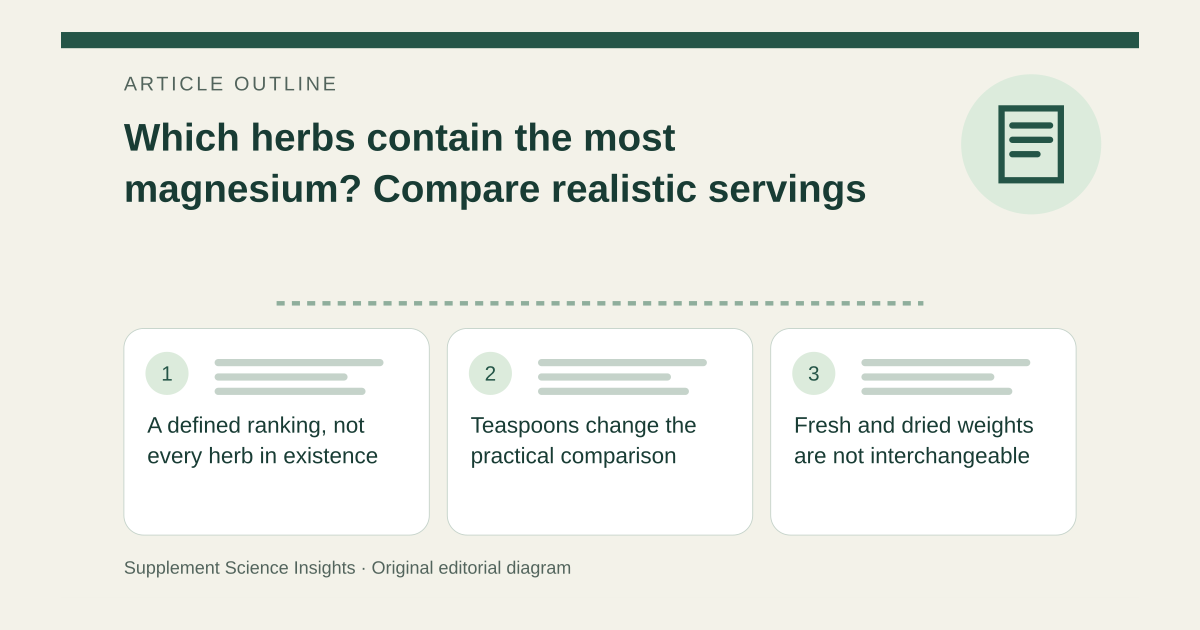
A defined ranking, not every herb in existence
Among the selected dried culinary herbs in USDA SR Legacy 2018, magnesium per 100 grams was 711 mg for basil, 451 mg for dill weed, 428 mg for ground sage, 400 mg for parsley and 377 mg for ground savory. These are historical reference estimates, not a laboratory measurement of your jar or an exhaustive ranking of every plant. [1]
Teaspoons change the practical comparison
The database teaspoon portions correspond to about 5 mg for dried basil leaves, 4.5 mg for dill weed, 3 mg for ground sage, 2 mg for dried parsley and 5.3 mg for ground savory. Different densities explain why the order changes when portions replace equal weights. Grinding and how tightly a spoon is filled also affect actual amounts. [1]
Fresh and dried weights are not interchangeable
The inspected fresh-basil record contains 64 mg per 100 grams, but its two-tablespoon chopped portion weighs 5.3 grams and contributes about 3.4 mg. Drying concentrates nutrients per weight as water is removed; it does not mean an ordinary sprinkle supplies a full dietary requirement. [1]
Build the meal around larger food contributions
NIH identifies foods such as legumes, nuts, seeds, whole grains and leafy green vegetables as magnesium sources. Herbs can make these foods appealing. Concentrated herbal extracts are not nutritionally interchangeable with a culinary serving, and taking large quantities of an herb is not necessary to obtain magnesium. [2]
Calculate the serving rather than trusting a headline
Imagine a dried herb contains 400 mg per 100 grams and the portion is 0.5 grams. Multiplying 400 by 0.5 and dividing by 100 gives 2 mg. A high per-100-gram number therefore need not mean a high contribution from a normal serving. [1]
| Measure | Hypothetical amount |
|---|---|
| Magnesium per 100 g | 400 mg |
| Portion weight | 0.5 g |
| Calculation | 400 × 0.5 ÷ 100 |
| Magnesium in portion | 2 mg |
Sources for this article
- USDA FoodData Central SR Legacy 2018: selected culinary herbs
Source consulted: 2026-09-21. This is a reference resource, not a claim that we conducted the studies or tested a product. - Magnesium - Health Professional Fact Sheet
Source consulted: 2026-09-21. This is a reference resource, not a claim that we conducted the studies or tested a product.