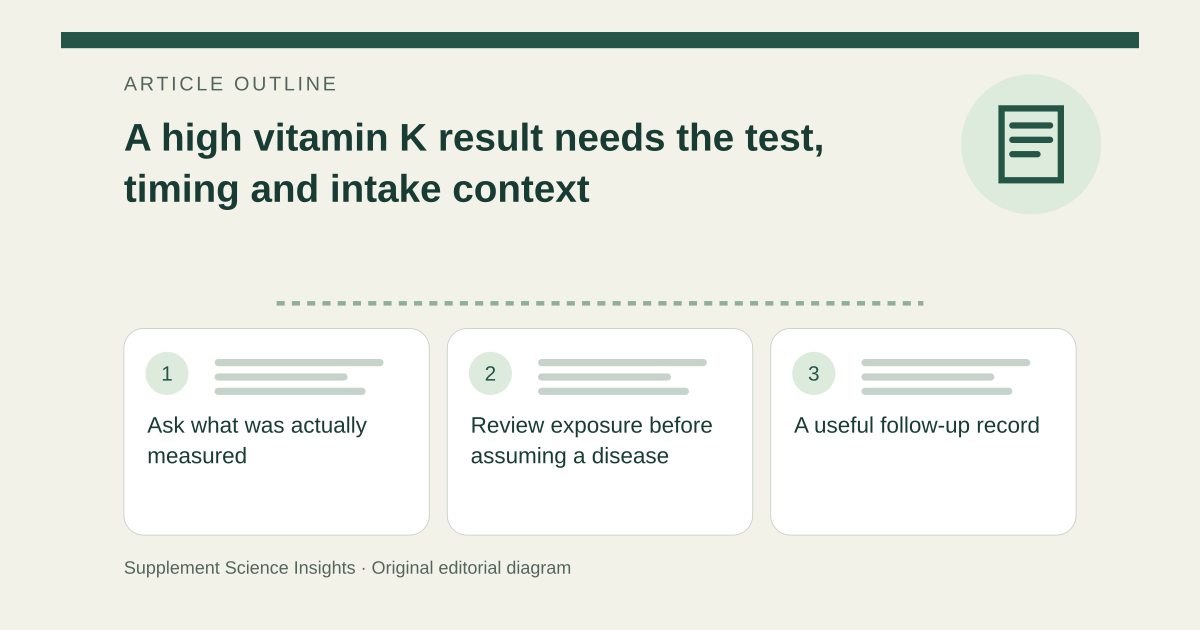
Ask what was actually measured
ODS notes uncertainty about using circulating phylloquinone to quantify overall vitamin K status. It does not capture every menaquinone contribution, and established normal ranges for menaquinones are lacking in that summary. A result should be interpreted using the laboratory’s analyte, units, reference interval and collection instructions. [1]
Review exposure before assuming a disease
Food and supplements supply vitamin K, and circulating vitamin K is carried in lipoproteins. Recent intake and the conditions of sampling therefore belong in the clinical review. The sources here do not provide a universal high-result diagnosis or a numerical toxicity threshold. No tolerable upper limit has been set because toxicity potential is low, but medication interactions remain important. [1]
A useful follow-up record
Imagine a result is flagged after a new K-containing supplement was started. Record its form, amount, timing and other products for the ordering clinician. If taking warfarin, avoid independently stopping all vitamin K foods or changing the medicine; consistency and clinician-directed monitoring matter. A flagged nutrient concentration is different from a clotting-management instruction. [1]
| Hypothetical information | Why it matters |
|---|---|
| K1 versus a menaquinone assay | Different analyte |
| Supplement taken before collection | Exposure and timing context |
| Warfarin use | Changes require coordinated review |
Sources for this article
- Vitamin K - Health Professional Fact Sheet
Source consulted: 2026-09-20. This is a reference resource, not a claim that we conducted the studies or tested a product.