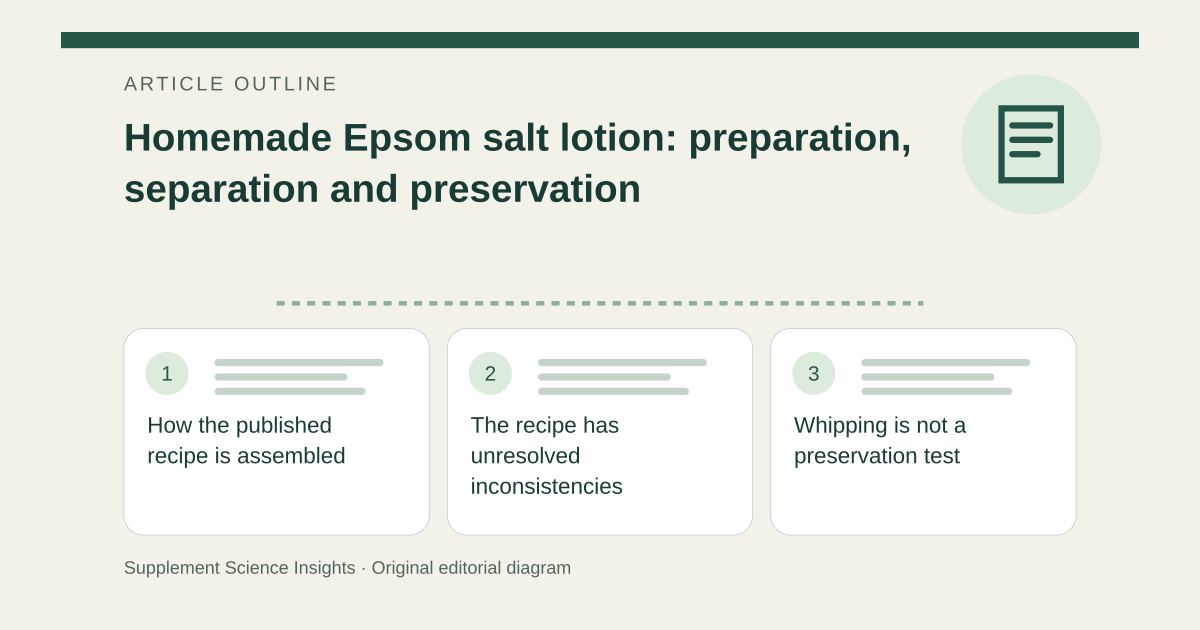
How the published recipe is assembled
The inspected CraftBits recipe dissolves Epsom salt in warmed distilled water, melts an oil-and-wax mixture separately, then blends the phases as they cool. This describes the published approach; it does not establish that the resulting mixture remains stable or microbiologically safe. [1]
The recipe has unresolved inconsistencies
Its ingredient quantities exceed the small yield stated in the introduction, and the author acknowledges separation. It also gives a months-long storage claim without presenting preservation testing. These problems prevent treating the recipe as a validated formula or simply scaling its claimed yield. [1]
Whipping is not a preservation test
FDA explains that cosmetics can become contaminated through water, ingredients, handling or ineffective preservation. A mixture that looks creamy after blending can still separate or support contamination. Adding extra water to adjust the texture changes the formulation and can dilute preservatives in a purchased lotion. [2][3]
What a dependable preparation would require
Before making a stored lotion, obtain a complete formula intended for this salt and use, including specified ingredients, processing, preservation and supported storage conditions. Do not invent a preservative amount or expiry date from appearance. A finished product intended for leave-on use avoids relying on this unvalidated home recipe. [2][3]
Separate moisturizing from magnesium treatment
Imagine a homemade mixture feels soothing when rubbed on dry legs. That experience does not establish correction of magnesium deficiency or treatment of cramps. The transdermal review does not support assuming a reliable systemic dose, and irritated or broken skin is not a place to test a salty mixture. [4][5]
| Observation | What remains unresolved |
|---|---|
| Salt dissolved in water | Final formulation suitability |
| Mixture looks creamy | Long-term stability |
| Clean jar used | Microbial preservation |
| Skin feels moisturized | Systemic magnesium absorption |
Sources for this article
- Epsom Salt Body Lotion Recipe — DIY Magnesium Lotion (Easy & Soothing) — CraftBits.com
Source consulted: 2026-09-21. This is a reference resource, not a claim that we conducted the studies or tested a product. - Microbiological Safety and Cosmetics | FDA
Source consulted: 2026-09-21. This is a reference resource, not a claim that we conducted the studies or tested a product. - Shelf Life and Expiration Dating of Cosmetics | FDA
Source consulted: 2026-09-21. This is a reference resource, not a claim that we conducted the studies or tested a product. - Myth or Reality—Transdermal Magnesium? - PMC
Source consulted: 2026-09-21. This is a reference resource, not a claim that we conducted the studies or tested a product. - DailyMed - EPSOM SALT SOAKING SOLUTION- magnesium sulfate granule
Source consulted: 2026-09-21. This is a reference resource, not a claim that we conducted the studies or tested a product.