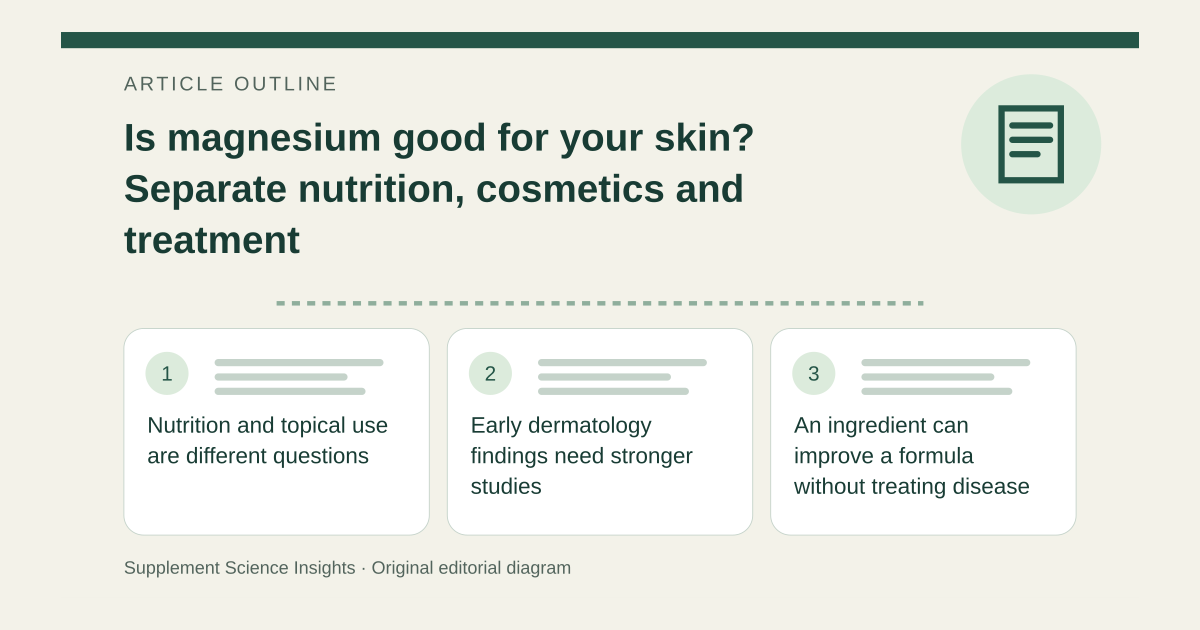
Nutrition and topical use are different questions
Meeting magnesium needs supports normal body function. That does not establish that adding magnesium to a cream delivers a useful systemic dose or treats a skin disorder. Oral intake, a cosmetic formulation role and a therapeutic skin claim require different evidence. [1][2]
Early dermatology findings need stronger studies
The inspected JAAD Reviews excerpt describes potential dermatologic uses but emphasizes small samples, varied formulations and inconsistent outcome measures. Larger human studies are needed to clarify effective preparations, doses and long-term safety. This is a bounded review summary, not proof that every magnesium product improves skin. [3]
An ingredient can improve a formula without treating disease
A magnesium-containing ingredient may help a cosmetic function as intended, but cosmetic ingredient safety is not evidence of efficacy for eczema or acne. FDA distinguishes beautifying or cleansing products from products intended to treat disease. Assess the exact claim rather than the mineral name. [4]
Retain condition-specific care
Established eczema and acne care depends on the diagnosis and severity. A salt spray should not replace prescribed treatment, and irritation after application is not a sign that the skin is detoxifying. Seek review when symptoms persist, worsen or suggest infection. [5][6]
Evaluate the whole product and outcome
Imagine dry skin improves after a person starts a moisturizer containing several ingredients, including magnesium. That does not isolate a magnesium effect or demonstrate systemic absorption. Skin comfort, irritation and the original condition are more useful outcomes than unsupported mineral-delivery claims. [3][2]
| Claim | Evidence needed |
|---|---|
| Meets nutritional needs | Dietary or clinical nutritional assessment |
| Improves cosmetic texture | Formulation-specific evidence |
| Treats eczema or acne | Condition-specific clinical evidence |
| Replaces magnesium through skin | Reliable systemic absorption evidence |
Sources for this article
- Magnesium - Health Professional Fact Sheet
Source consulted: 2026-09-21. This is a reference resource, not a claim that we conducted the studies or tested a product. - Myth or Reality—Transdermal Magnesium? - PMC
Source consulted: 2026-09-21. This is a reference resource, not a claim that we conducted the studies or tested a product. - The role of magnesium in dermatology — indexed publisher abstract and discussion
Source consulted: 2026-09-21. This is a reference resource, not a claim that we conducted the studies or tested a product. - Cosmetics Safety Q&A: Personal Care Products | FDA
Source consulted: 2026-09-21. This is a reference resource, not a claim that we conducted the studies or tested a product. - Atopic eczema - NHS
Source consulted: 2026-09-21. This is a reference resource, not a claim that we conducted the studies or tested a product. - Acne: Diagnosis and treatment
Source consulted: 2026-09-21. This is a reference resource, not a claim that we conducted the studies or tested a product.