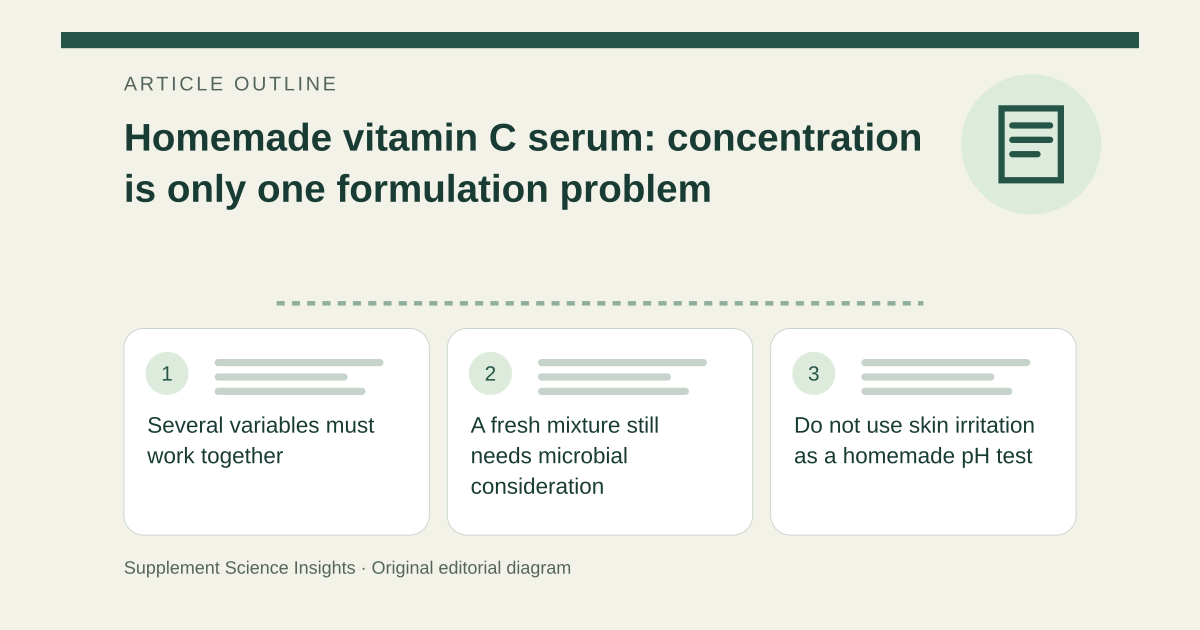
Several variables must work together
The vitamin C form, pH, vehicle, packaging and stability influence topical delivery. The 2017 reviews describe these formulation challenges and limited comparisons between products. Measuring powder accurately solves only one part of the problem; it does not show how much active vitamin reaches the skin. [1][2]
A fresh mixture still needs microbial consideration
Water-containing cosmetics can become contaminated through ingredients, packaging and repeated handling. FDA’s guidance highlights the importance of an effective preservation system. Making a small batch or keeping it cold does not by itself validate a storage period or eliminate the need for suitable formulation controls. [3]
Do not use skin irritation as a homemade pH test
Imagine a mixture stings strongly, so the maker assumes it is more active. Stinging does not quantify pH or penetration, and skin injury is not a quality-control method. Choose a preparation intended for topical use rather than adjusting household acids until the sensation seems strong enough. [4][1]
| Question | Practical interpretation |
|---|---|
| Measured percentage | One formulation variable |
| No visible change | Not proof of microbial safety |
| Strong stinging | Not a validation test |
Sources for this article
- Topical Vitamin C and the Skin: Mechanisms of Action and Clinical Applications - PMC
Source consulted: 2026-09-20. This is a reference resource, not a claim that we conducted the studies or tested a product. - The Roles of Vitamin C in Skin Health - PMC
Source consulted: 2026-09-20. This is a reference resource, not a claim that we conducted the studies or tested a product. - Microbiological Safety and Cosmetics | FDA
Source consulted: 2026-09-20. This is a reference resource, not a claim that we conducted the studies or tested a product. - How to test skin care products
Source consulted: 2026-09-20. This is a reference resource, not a claim that we conducted the studies or tested a product.