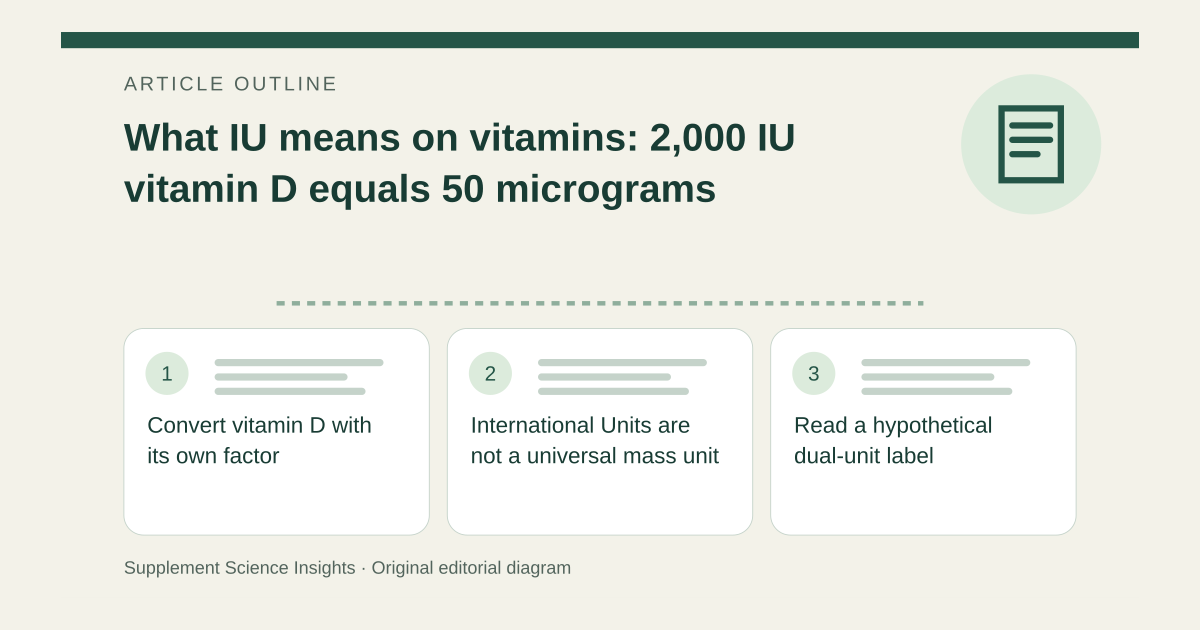
Convert vitamin D with its own factor
For vitamin D, NIH ODS specifies 1 microgram (mcg or µg) = 40 IU. Divide IU by 40 to get micrograms: 400 IU is 10 mcg, 1,000 IU is 25 mcg and 2,000 IU is 50 mcg. To go the other way, multiply micrograms by 40. These are two ways to state the same vitamin D amount, not two separate ingredients to add together. [1]
International Units are not a universal mass unit
An IU refers to a standardized amount of biological activity for the particular substance. Vitamin A uses different conversions that also depend on the form, so a vitamin D calculation cannot interpret every IU label. Milligrams and micrograms are mass units; the relation 1 mg = 1,000 mcg does not change between nutrients. [1][2]
A correct conversion identifies an amount, not whether it is an appropriate personal dose. For vitamin D, age, total intake and clinical context still matter. Do not treat a larger IU number as evidence of a better product. [1][2]
Read a hypothetical dual-unit label
Imagine one serving says vitamin D 50 mcg (2,000 IU). It supplies 50 mcg, not 50 plus another 2,000 units of mass. Two identical servings supply 100 mcg or 4,000 IU. This demonstrates scaling only; it is not advice to double a serving or a dosing plan. [1]
| Declared amount | Equivalent vitamin D amount |
|---|---|
| 1,000 IU | 25 mcg |
| 2,000 IU | 50 mcg |
| 4,000 IU | 100 mcg |
Sources for this article
- Vitamin D - Health Professional Fact Sheet
Source consulted: 2026-09-20. This is a reference resource, not a claim that we conducted the studies or tested a product. - Vitamin A and Carotenoids - Health Professional Fact Sheet
Source consulted: 2026-09-20. This is a reference resource, not a claim that we conducted the studies or tested a product.