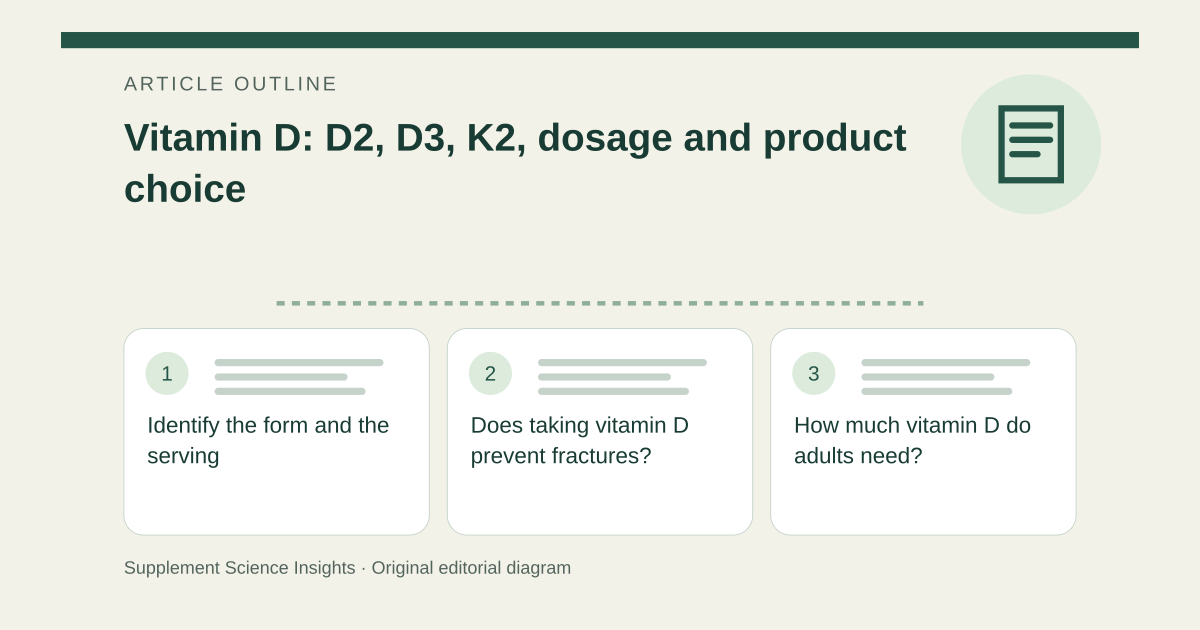
Identify the form and the serving
Vitamin D supplements can contain D2, called ergocalciferol, or D3, called cholecalciferol. ODS explains that both can raise blood vitamin D, while the response can differ. That fact does not identify the right product or amount for an individual. [1]
Copy the form, amount, unit and serving size as a group. For drops, gummies or combination products, the number of units in a serving matters just as much as the large number on the front label. [1]
Does taking vitamin D prevent fractures?
Correcting vitamin D deficiency and giving extra vitamin D to generally healthy adults are different clinical questions. In the VITAL fracture study, 2,000 IU of D3 daily did not significantly lower total, nonvertebral or hip fractures over a median 5.3 years. The 25,871 participants were not selected for deficiency, osteoporosis or low bone mass. [4]
This result does not mean that deficiency should be ignored. It does mean a large dose on a label is not evidence that a supplement prevents fractures in someone already adequately supplied. A medical treatment plan may include considerations beyond this trial, including calcium intake, bone disease and the reason for testing. [4]
How much vitamin D do adults need?
The U.S. recommended intake is 600 IU (15 micrograms) per day for adults through age 70 and 800 IU (20 micrograms) after 70, from food and supplements together. The adult upper limit is 4,000 IU (100 micrograms) daily; it is a safety boundary, not a target. Clinician-directed deficiency treatment can differ. [2]
D2 and D3 can both raise vitamin D status. D3 often produces a larger or more sustained rise, but the measured blood response does not establish a universal disease-prevention benefit. Taking vitamin D with a meal containing some fat can improve absorption; evidence does not identify one best clock time for everyone. [2]
Do you need vitamin K2 with vitamin D3?
Vitamin K participates in blood clotting and proteins involved in bone metabolism. That biological relationship does not establish that everyone taking D3 needs a K2 supplement, or that adding K2 prevents the harms of excessive vitamin D. Trials of bone outcomes and vascular calcification do not provide a universal combination prescription. [3]
Keep the K form and amount visible rather than treating MK-4 and MK-7 as interchangeable label terms. Vitamin K can seriously interfere with warfarin and other vitamin K antagonists. People using these medicines should discuss any supplement change with the clinician managing anticoagulation; a combination marketed for bones is still relevant to that medicine plan. [3]
How to choose between drops, gummies and tablets
Choose a format you can measure and use consistently, then compare the declared amount per serving. For drops, distinguish per-drop from per-milliliter instructions. For gummies, count the units in a serving and check other ingredients. A preferred texture does not establish better absorption or more accurate contents.
For vegan D3, verify the stated source and capsule ingredients on the exact product, rather than inferring vegan status from “D3.” For independent testing, verify the exact product in the certifier’s own directory. Keep price per labeled serving separate from evidence that supplementation is needed. Neither a bestseller rank nor a high IU count answers the latter question.
When does a blood test change the decision?
A 25-hydroxyvitamin D test can be useful in a clinical assessment, but routine testing is not automatically useful for every healthy adult. Symptoms, health conditions, medicines and prior results affect whether a test is indicated and how it is interpreted. [2]
There is no fixed number of days in which every deficiency is corrected. The starting concentration, prescribed regimen, absorption and adherence all matter. Follow-up belongs to the treatment plan; do not repeatedly escalate a supplement because a symptom has not changed. Excessive vitamin D can raise calcium and injure the kidneys. [2]
Two units can describe the same labeled amount
The ODS intake table pairs 10 micrograms with 400 international units. The relationship is 40 IU for each microgram of vitamin D. In an invented label example, 25 micrograms and 1,000 IU describe the same amount, not two quantities to add together. [1]
This is a conversion exercise only. It is not a suggested serving, a daily target or a deficiency-treatment instruction. A correct conversion cannot establish whether the amount is suitable. [1]
| Calculation | Result |
|---|---|
| 25 micrograms × 40 IU per microgram | 1,000 IU |
| 25 micrograms and 1,000 IU | Two units describing one amount |
| Personal suitability | Not answered by the conversion |
| Blood concentration | Separate measurement; not converted here |
A blood concentration is a different measurement
Vitamin D status is commonly discussed using a blood measurement of 25-hydroxyvitamin D. Concentration units such as ng/mL or nmol/L are different from the micrograms or IU listed for an oral amount. [1]
Keep a laboratory report and an intake record in separate columns. Do not use the label conversion above to convert a blood result into a personal supplement dose. Interpretation depends on clinical context and belongs with a qualified health professional. [1]
Record combinations without double-counting
A person’s product list may contain a multivitamin, a standalone vitamin D product and another combination. For a documentation exercise, record each label separately and note what is actually used. Do not assume that different product names mean their contents never overlap.
For any one label, choose a consistent unit before comparing amounts. If a photograph does not show the serving size or the directions, mark that information as missing. An incomplete image is not enough to construct a daily intake record.
More is not automatically a better plan
Excessive supplemental vitamin D can cause serious harm. ODS identifies medication interactions, including a risk of elevated calcium with thiazide diuretics. Review the whole supplement and medicine list with a clinician or pharmacist. [1]
A treatment regimen prescribed for a diagnosed condition and an unsupervised supplement choice are different situations. This page does not recommend high-dose schedules, routine testing intervals or interpretation thresholds. [1]
How to use this evidence
Use the sections above to match a question with the preparation, population and outcome actually studied. Follow the related reading for more detailed questions; a useful comparison may still end with uncertainty rather than a winning product.
This is an editorial evidence guide, not a systematic review or individual medical advice. No new clinical review credentials, product tests or personal treatment plan are implied. Study protocols and fictional value examples are identified as such.
Sources for this article
- NIH ODS — Vitamin D: Consumer Fact Sheet
Source consulted: 2026-09-17. This is a reference resource, not a claim that we conducted the studies or tested a product. - NIH ODS — Vitamin D: Health Professional Fact Sheet
Source consulted: 2026-10-28. This is a reference resource, not a claim that we conducted the studies or tested a product. - NIH ODS — Vitamin K: Health Professional Fact Sheet
Source consulted: 2026-10-28. This is a reference resource, not a claim that we conducted the studies or tested a product. - LeBoff et al. — Supplemental Vitamin D and Incident Fractures in Midlife and Older Adults
Source consulted: 2026-10-28. This is a reference resource, not a claim that we conducted the studies or tested a product.
Considering a supplement?
Ingredient evidence alone does not establish which retail product is suitable. The featured option illustrates the label and formulation context above; it is not a clinical efficacy ranking.
Compare vitamin d formulations (retail checks pending) → No overall winner
Compare formulations → · How we select products